
On Friday evening, Connie Hedgepeth told a Durham courtroom that she forgave Miguel Salguero-Olivares, the man convicted of killing her daughter Faith, a 19-year-old University of North Carolina student, in 2012.
“We try to raise our children the best we know,” she said in victim impact statements just before sentencing. “But it just seemed like it was such a senseless and cruel act. We have to go on, and we just have to trust God and just go on with our lives. She’s in a better place than we will ever be here on this earth.”

Connie and Roland Hedgepeth, Faith’s father, waited for more than 14 years for closure. Faith was found dead in her apartment on Sept. 7, 2012, at the Hawthorne at the View complex near the Durham-Chapel Hill line. The case remained open for nine years before Salguero-Olivares was arrested for DWI in 2021. State and local investigators then linked him to DNA evidence at the crime scene and later charged him with first-degree murder, burglary, sexual offense and rape.
The trial began on Sept. 28 with jury selection. Nearly a month later, on Oct. 25, the group of 12 jurors reached a unanimous decision. At approximately 5:35 p.m., Judge Keith Gregory announced their verdict: guilty on all counts.
The judge sentenced Salguero-Olivares to life in prison without the possibility of parole, as is mandatory for a first-degree murder conviction. The Durham County District Attorney’s Office had previously decided not to seek the death penalty in this case. Salguero-Olivares’ attorneys have filed an appeal on his conviction.
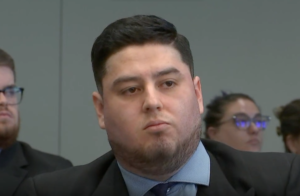
In a press conference following the verdict, District Attorney Satana Deberry spoke to the effort the prosecution put into preparation for the trial. “We have really been working on this case almost every day for the last two years,” she said.
Throughout the trial, the prosecution framed the case as a brutal crime without reason. In her 18-minute opening statement, Assistant District Attorney Angela Garcia-Lamarca told the jury that Salguero-Olivares was a stranger to Hedgepeth and committed the crimes in “a fit of rage.” Prosecutors proceeded to call a series of witnesses to testify about who Hedgepeth was and other details about the case.
After Hedgepeth’s niece testified, the second witness was Karena Rosario, Hedgepeth’s roommate and close friend. Rosario was subject to considerable scrutiny in the years following the murder, as she had been with Hedgepeth just before the presumed time the murder took place. In a pretrial hearing in September, Judge Gregory ruled that the defense could not implicate Rosario in its arguments.

Still, defense attorney James Rainsford raised questions in cross-examination over details Rosario told investigators in recounting the evening. He asked why Hedgepeth would not have checked on Rosario during the hour that Rosario was throwing up in their shared bathroom, by way of questioning whether Rosario truly did not see Hedgepeth after going into the bathroom. He suggested it was unusual for her not to have rinsed out her mouth or brushed her teeth when she was preparing to leave the apartment, which could have connected her to the red stains found around the bathroom sink by investigators.
He also asked why she did not bring anything with her when she left the apartment at 4:30 a.m. with a friend, Jordan McCrary, since she had class the next morning. There were other red stains found on the bathroom doorframe and in McCrary’s car, and McCrary testified that Rosario noted unexplained blood on her finger while he was driving her to his home.
In her testimony, Rosario described having a very close relationship with Hedgepeth, calling her “easy to open up to, easy to love, just an easy friend” who felt like a sister to her. She explained the emotional turmoil she underwent at that time in her personal life, including a recent abortion and a former abusive romantic relationship. She confirmed that she had found Hedgepeth in the late morning on Sept. 7 and called 911. She continued to speak with police during the investigation, and kept the same phone number so investigators could still reach her.
“I wanted to be helpful and I wanted to know what happened,” she said.
Deberry and special prosecutor Lisa Coltrain addressed the speculation around Rosario in the final press conference, saying the prosecution never thought Rosario was involved.
“From the first time that we met with her, it was apparent, abundantly apparent, that despite all of the scrutiny that she has lived under, that she desperately loved Faith and missed Faith and that she wanted justice for Faith as well,” Coltrain said. “I hope that this, today, will allow her to move forward with her life in a way that she has not been able to for a long time.”
As the trial went on, the prosecution proceeded to call witnesses to explain the DNA evidence collected and tested that linked the crime to Salguero-Olivares. Erin Ermish, an investigator from the state’s crime lab, testified across three days.
She testified about the strength and certainty of these DNA matches: using the rectal swab taken from Hedgepeth’s body, the DNA mixture found “is approximately 170 septillion times more likely if it originated from Faith Hedgepeth and Miguel Enrique Salguero-Olivares” than from Hedgepeth and an unknown male, she said. (A septillion is a one followed by 24 zeros.) Regarding the DNA mixture found on vaginal swabs, she said it is 114 septillion times more likely. On testing the top of the Bacardi rum bottle that police believe was the murder weapon, she said it is “approximately 48.6 tredecillion” times more likely to be DNA from Hedgepeth and Salguero-Olivares than unknown contributors. (A tredecillion is a one followed by 42 zeros.)
In cross-examination, Rainsford asked why Ermish tested some spots but not others and about the process behind calculating the likelihood ratios based on three population groups. The defense suggested throughout the trial that a sexual encounter between Hedgepeth and Sanguero-Olivares could have been consensual, and that semen can live for days inside a person’s body.
Another witness was Summer Maffett, a forensic scientist manager at the crime lab, who said a palm print on a Riesling wine bottle found in the bedroom matched Salguero-Olivares, whereas fingerprints collected from a rum bottle which investigators believed to be the murder weapon lacked enough detail for comparison.
Rainsford criticized the investigation for failing to test certain pieces of evidence for DNA: there was a red stain on the doorway of the apartment bathroom that was swabbed but then lost before it could be tested, the stain on the passenger side door of McCrary’s car came back inconclusive, and investigators did not swab the screen of Hedgepeth’s cell phone. He asked why forensics scientists did not test surfaces such as the apartment doorknob — Ermish pointed out that these do not typically lead to good results, as scientists have to eliminate standards from everyone who could’ve touched them in normal circumstances.
Then there was the question of motive. Although prosecutors are not required by law to prove a motive, the defense was adamant that the state did not meet the burden of proof necessary to show that Salguero-Olivares murdered Hedgepeth.
A key part of the prosecution’s argument was that Salguero-Olivares may have been at a cookout with some residents of Hawthorne at the View that night, in the apartment grill area close to Hedgepeth’s unit. However, when the prosecution called the host of that cookout, Luis Lopez, to the stand, he could not conclusively say if Salguero-Olivares was in fact there. Both Lopez and Salguero-Olivares were originally from Guatemala, and several Guatemalan immigrants lived at Hawthorne at the View.
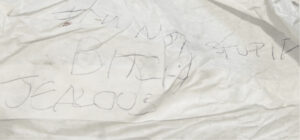
Another key mystery in the investigation was a note handwritten on a takeout bag found on the bed next to Hedgepeth that read, in three lines: “I’M NOT STUPID BITCH JEALOUS.” Prosecutors suggested the note was written by Salguero-Olivares, drawing upon an image discovered on his laptop as a handwriting comparison. Yet, an agent told the court in testimony that he recently learned the image was actually a widely circulated meme.
Ultimately, defense attorneys opted not to call any witnesses, due in part to the state’s perceived inability to meet its burden of proof. This move was not altogether surprising to other defense lawyers, who told The 9th Street Journal that if the defense were to present evidence, they would forfeit their ability to deliver the final remarks to the jury during closing arguments.
“Do [witnesses] add anything and do they risk the chance of getting tripped up on cross-examination? The state has the burden of proof. They have to prove their case,” said longtime Durham defense attorney Daniel Meier in an interview.
Even though prosecutors did not get the final word, their closing argument still proved convincing enough for the jury to reach a unanimous decision, although jurors told ABC11 four of them had initial doubts. Garcia-Lamarca proposed a theory that Salguero-Olivares tried to engage Hedgepeth and Rosario that night in the parking lot and was shut down, so when he later saw Rosario leave, he acted out of rage against Hedgepeth.
“For parents to lose a child and not know what happened, who did it, is unbearable,” Garcia-Lamarca said during closing arguments. “Now we know. We know what happened. Forensic evidence in this case is screaming the truth. We know what happened.”
Sophie Endrud
