All 2,000 households in the Watts-Hospital Hillandale and Old West Durham neighborhoods just received a special delivery: the spring edition of Parade.
From the front-page introduction of the Old West Durham neighborhood association’s new president, through the “Comings & Goings” page announcing move-ins and graduations, to the page 9 history tidbit, the newsletter gives residents a quarterly status update.
“People love it,” said editor Brandee Gruener. “I think in this day and age, it’s kind of hard to get that kind of localized information about what is being put up in that parking lot over there, or what is going on with the sidewalks…so we try to be really thorough and share everything of interest to the neighborhood.”
Like many other communities, both Durham neighborhoods have hyperactive listservs for announcements and general chatter. Yet Parade is one of few remaining neighborhood print publications, joined by Trinity Park News and The Porch Light in Tuscaloosa-Lakewood. And all three are entirely volunteer-run.
In the fall of 1984, Watts-Hospital Hillandale formed a neighborhood association in response to zoning and traffic issues, said Tom Miller, who was involved in its creation. Namely, the city wanted to make Ninth Street and Broad Street into parallel one-way streets and to bring in nonresidential development.
Parade: More than 50 years chronicling neighborhood news
The next natural step was a newsletter, named after the neighborhood’s annual Fourth of July parade. The publication began quarterly distribution in spring 1985. The newsletter has published continually since then — the Durham County Library has a complete collection.
“Originally, its format was very basic,” Miller said. The smallest edition was four pages on legal size paper, he estimated.
“It was originally produced with dot matrix printing, because that was what home computers were like back then. We started the newsletter when PCs were a brand-new idea,” he said.
He wrote his first article, lamenting a street-widening project, at 28 years old. Now, at 70, he has contributed to every issue alongside newer volunteers.
Miller, who worked in real estate regulation for the state attorney general’s office before his retirement, often contributes development updates to the “Heart of the Neighborhood” section. This spring, the round-up featured the Jean’s “By the Sea” restaurant opening in February and the Indian Trail Park bridge repair, among other items.
“Tom does an amazing job of keeping tabs on all the development coming to the neighborhood,” Gruener said.
The newsletter has become more journalistic and less “folksy” under the leadership of Gruener, a digital editor for Southern Living and journalist since 2001.
Gruener typically allows about four weeks between calling for submissions and distributing the final product. She doesn’t turn down a submission “unless it just really, really had nothing to do with the neighborhood at all,” she said.
Trinity Park’s hyper-local newspaper
Like Gruener, Trinity Park News editor and former Durham school board member Steve Unruhe has a background in journalism — he taught the subject at Riverside High School for 29 years. For Unruhe, a Trinity Park resident for over 40 years and a Trinity Park Neighborhood Association board member, the role was a natural fit.
Trinity Park News goes to all 1,400 homes, and Unruhe accepts stories written by any resident, which he edits mostly for grammar and spelling.
“It’s a neighborhood newsletter, so whatever people write, that’s what goes in,” he said.
“I think that the TPNA newsletter is excellent — well-written, nicely laid out, short on useless stuff, and highly informative,” resident Gary Berman said over email.
Its spring edition begins with advertisements for home tour volunteers, a Spring Egg Hunt and Trinity Park merchandise before jumping into articles about tree planting, creek clean-up, changes at Durham School of the Arts and the City Council traffic budget. While neighborhood association bios and a charming “Meet Your Neighbor” section persist, Unruhe said contributions have become less “feature-y” and more newsy over time.
“I think we’re more inclined to write what I would call a ‘news story’ now because of the decline in local news,” Unruhe said.
Nationally, almost 40% of all local newspapers have vanished. In Durham, Miller used to receive three papers daily: the Durham Morning Herald, the Durham Sun and the Raleigh News & Observer. The Durham Herald-Sun (the two Durham papers merged in 1991) ceased being an independent publication when it was bought by the News & Observer in 2016. The News & Observer has outlasted industry struggles, yet it has seen decreased circulation and staff.
“The Durham Sun, especially, concentrated on very local things,” Miller said. “You got wedding announcements…you could read about people going and coming from Europe on vacation…the whole community was there.”
In Tuscaloosa-Lakewood, a dual-language publication
Tuscaloosa-Lakewood has published The Porch Light two to four times per year since the 1990s, estimated Susan Sewell, 73. The neighborhood has around 600 houses and a few apartment buildings. Sewell coordinates the newsletter’s printing and distribution and contributes the occasional voting-related article.
The two-page newsletter focuses on important dates and neighborhood events. Ten years ago, the association began including Spanish translations of each edition to accommodate the neighborhood’s growing number of Spanish speakers.
On distribution day, every volunteer is assigned between 40 and 60 doors. Sewell typically hears positive feedback during her deliveries.
“I have my route that I’ve had since 2002,” she said with a soft laugh. “Which is Chapel Hill Road from Huron to 15-501…It’s funny, you know, I can tell you when a house is for sale.”
Julia Gamble, a self-proclaimed “newshound” who lives on the border between Old West Durham and Watts-Hillandale, is usually at work when Parade is delivered.
“We find them on the doorstep, and then we’re really excited, and then we pass them around, and we all read them, including the adolescent in the household,” she said.
“What I really love about the pieces that are in the newsletter are that they kind of help me understand how things happen, and then also my ability to in some way influence them.”
She recalled finding out she could write to City Council to keep the green space on Green Street, for example.
“So as a news source, it informs me of what might be happening, of who is making it happen, and of also how I, as a citizen, might be able to speak to it, pro or con,” she said.
‘We share a story’
Steve Cohn, 76, has lived in the same Watts-Hillandale home since 1980, when Liggett and Myers and American Tobacco were still large local employers.
“When I moved in…everyone who lived there were still the people who had built the houses there in the 1940s,” he said. “We were the youngest people on the block, we had the only child on the block, and I think much of the neighborhood was that way.”
When new residents moved in, Parade was one of the ways to pass along the community spirit, he said.
John Schelp, a local history fanatic and longtime Old West Durham resident, has seen a similar transition on his own block. A former president of the Old West Durham Neighborhood Association, he said civic engagement and community volunteering give him a sense of purpose.
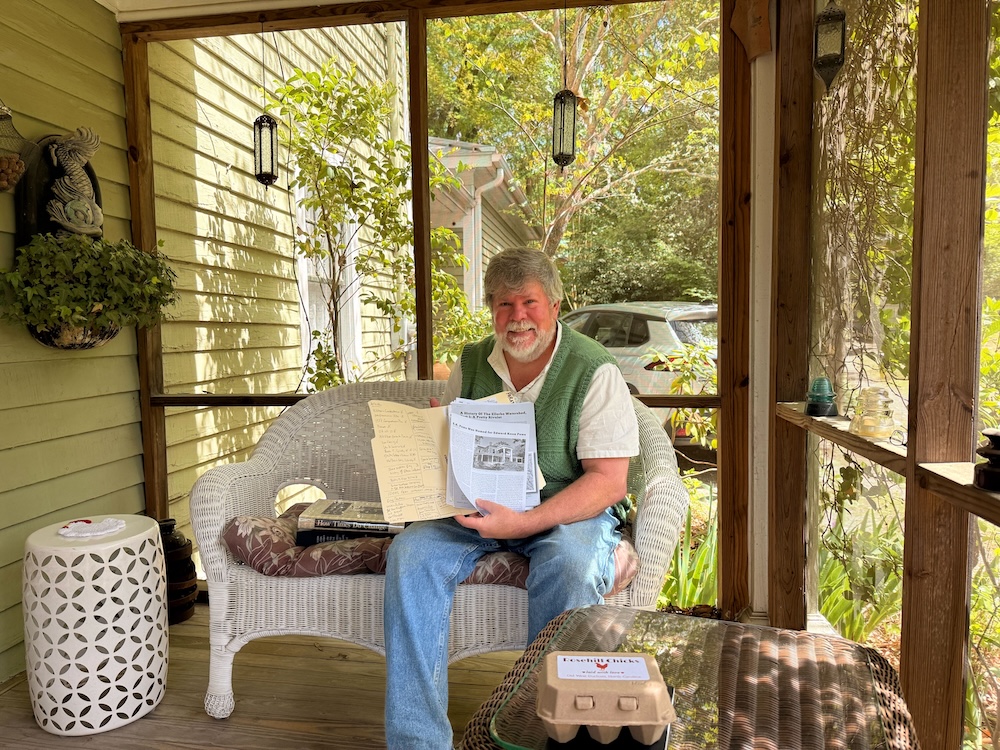
Schelp hosts Durham walking tours and shares history tidbits on his @postcardsfromdurham Instagram account. He has been writing Parade’s history column since September 2020, keeping track of topics he’s covered by crossing them off in a manila folder. Most recently, he wrote about old street cars and a 1941 poem called “Ninth Street Myth” by George Zabriskie, a gloomy depiction of Durham’s former textile mills.
Sitting on his screened-in porch on Rosehill Avenue, chickens clucking in the distance, he pointed to the one- to two-story houses around him with small front yards, porches facing the street and, often, shared driveways.
“The whole architecture of the neighborhood, like the newsletter, is built to get to know your neighbors, to sit on your porch and talk without shouting to someone walking by,” he said.
“And the newsletter…we have a common story,” he said. “Whether it’s the history, whether it’s what’s going on with the new apartments on Hillsborough Road, whether it’s the new shops coming into Ninth Street, what’s happening to the old laundromat…We share a story.”
Above: John Schelp writes the local history column for Parade. Photo by Sophie Endrud — The 9th Street Journal
Sophie Endrud