On Monday, prosecutors finished presenting evidence in the murder trial of Faith Hedgepeth, a UNC Chapel Hill student found dead Sept. 7, 2012. Over the course of nine days, they called 23 witnesses. Miguel Salguero-Olivares is charged with rape, sexual offense, burglary and murder.
When court resumed Wednesday after a one day break, defense attorneys revealed they would not be calling any of the 177 witnesses they initially said they might, and that Salguero-Olivares would not testify in his own defense. Closing arguments are set to begin Thursday morning.
Below are five key takeaways from the trial so far.
1. DNA evidence
A key component of the state’s argument was that DNA evidence connected Salguero-Olivares to the crime scene. Salguero-Olivares was charged with DWI in 2021 and his DNA was collected. It was then that investigators linked him, through that DNA, to the Hedgepeth case.
Prosecutors called expert witnesses from the state crime lab to testify about the strength and certainty of these DNA matches, in dense testimony that lasted three days.
DNA that matched Salguero-Olivares’ DNA profile with a high probability was found on a vaginal swab and rectal swab from Hedgepeth’s body, they testified. Erin Maffett, a forensic scientist manager at the crime lab, said a palm print on a Riesling wine bottle found in the apartment matched Salguero-Olivares, whereas fingerprints on a rum bottle which police believe to be the murder weapon lacked enough detail for comparison.
Throughout the trial, the defense has sought to infer that a sexual encounter could have been consensual, and that semen can live for days in a person’s body.
2. Hedgepeth’s roommate, Karena Rosario
A lot of speculation has swirled around Hedgepeth’s roommate, Karena Rosario, and her account of the hours surrounding Hedgepeth’s death. She was among the first witnesses called in the trial.
While the prosecution sought to establish her as a devoted friend who tirelessly helped police conduct their investigation, the defense tried to diminish her credibility and raise questions about her role.
Ahead of the trial, Judge Keith Gregory ruled that the defense could not argue Rosario’s guilt during the trial. Rosario has not been charged with a crime, and Judge Gregory ruled that despite any questions surrounding Rosario, the defense could not adequately prove that Salguero-Olivares had not been involved, which would have been necessary.
Still, defense attorney James Rainsford tried to raise doubt about Rosario’s credibility during cross-examination. Rainsford questioned her about her testimony that she did not interact with Hedgepeth between going into their shared bathroom, throwing up, and leaving with her friend, Jordan McCrary, around 4:30 a.m. Sept. 7.
Rainsford asked Rosario about blood stains found in their apartment and McCrary’s statements about blood on Rosario’s hand when she got into his car. Rosario was adamant that there was no reason for her to have been in contact with any blood, and that any red stains were likely from vomit. He also questioned her about leaving the apartment door unlocked when she left to meet McCrary. He questioned why Rosario called Hedgepeth 14 times in 90 minutes later that morning, before returning home to find Hedgepeth’s body.
Rosario testified on direct examination that, in September 2012, she was going through a difficult period in her life, having recently gotten an abortion. She told the court that she was “kind of a wreck” during that time.
3. Untested and lost evidence
A key point raised by the defense is the untested evidence or otherwise lost or missing evidence in the case. Will it cause the jury to question the integrity of the investigation, and its results? Or will the evidence that was tested be enough to satisfy the jury?
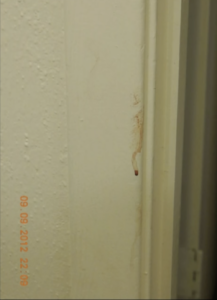
Throughout the trial, Rainsford criticized the investigation, including why some objects were tested for DNA and others were not. He stressed that a red stain in the doorway of the apartment bathroom was swabbed but then not tested, and subsequently lost.
Rainsford pressed investigators and crime lab scientists on why they did not take DNA samples from the apartment doorknob or laundry area, and why only portions of the rum bottle were swabbed for DNA.
4. Note at the crime scene
On the bed Hedgepeth and Rosario shared, investigators say they found a handwritten note reading “I’M NOT STUPID BITCH JEALOUS.” Prosecutors believe the note was written by Salguero-Olivares.
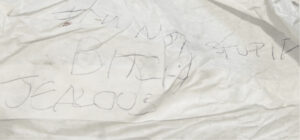
Friday, an SBI agent testified that he found an image on Salguero-Olivares’ laptop containing a handwritten note, and offered it to the court to consider as a handwriting comparison to the note left at the scene. Both were written in all capital letters.
Yet, on Monday, the agent told the court he learned over the weekend that the image from Salguero-Olivares’ computer was actually a widely-circulated meme. Rainsford used this error to try to cast doubt on investigators’ handling of the case as a whole, and question if other incorrect assumptions had been made.
5. No motive established
Prosecutors have not established a motive for Salguero-Olivares to have committed the crimes. While they are not required to prove a motive, not knowing the “why” behind alleged crimes could impact jurors’ viewpoints.
In opening statements, Assistant District Attorney Angela Garcia-Lamarca stated that in the hours leading up to Hedgepeths’ death, Salguero-Olivares was at a cookout at Hawthorne at the View, the apartment complex where Hedgepeth lived.
The prosecution called the host of that cookout, Luis Lopez, to the stand. However, he could not conclusively say if Salguero-Olivares was in fact there.
Lopez testified that he did not know Hedgepeth, though he had seen her in the parking lot previously. Lopez said he hosted the cookout in the apartment grill area, which was near both his and Hedgepeth’s apartments. He testified that it began the afternoon of Sept. 6, 2012, and extended into the early morning hours of Sept. 7.
Lopez said there was one person at the cookout he did not know, but he was unable to definitively attest to whether or not that person was Salguero-Olivares, as prosecutors suggested. Lopez acknowledged that he was drinking that night, and it affected his memory of the events. Prosecutors did not provide any more detail as to why Salguero-Olivares would have been at the cookout on the night of Hedgepeth’s murder. Prosecutors had previously highlighted that both Lopez and Salguero-Olivares were originally from Guatemala, and that several Guatemalan immigrants lived at Hawthorne at the View.
Prosecutors have said that Salguero-Olivares and Hedgepeth did not know each other. Hedgepeth’s friends who testified in trial similarly said they did not recognize Salguero-Olivares.
The defense has elected not to call any witnesses, and Salguero-Olivares has chosen not to testify in his own defense. A defendant is innocent until proven guilty. Rainsford argued that prosecutors did not meet their burden. Soon, the jury will decide.
fiona shuldiner