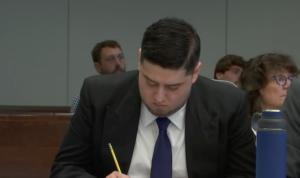
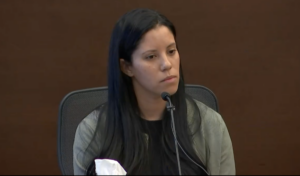
It has been 14 years since the body of University of North Carolina student Faith Hedgepeth was discovered in her apartment, four miles from the Chapel Hill campus. The case quickly became a widely-covered mystery: the young woman had been beaten and raped, there were no known suspects or motive, and police released few details about the circumstances. On Monday, when the trial for the accused murderer begins, we may finally begin to hear some answers.

Hedgepeth, a 19-year-old student at UNC, was found dead on Sept. 7, 2012. The incident was reported in a late morning 911 call from Hedgepeth’s roommate. What seemed at first like a clear-cut investigation later proved to be a local and national phenomenon. The case has attracted national attention ranging from the Crime Junkie podcast to NBC’s Dateline.
Nine years after the killing, a drunk driving arrest in a neighboring county finally led police to a suspect. Police used DNA analysis to link Miguel Enrique Salguero-Olivares to Hedgepeth’s killing, and charged him with murder, first-degree burglary, first-degree rape and first-degree sexual offense. The trial begins Sept. 28.
How the crime unfolded
Faith Hedgepeth was a junior at UNC, studying biology with a Gates Millenium Scholarship, an award for high-achieving students from minority backgrounds. Hedgepeth, from Warrenton, N.C., a small town about 70 miles northeast of Chapel Hill, belonged to the Haliwa-Saponi American Indian Tribe. She lived in an apartment complex called Hawthorne at the View, on Old Chapel Hill Rd. in Durham, with her roommate Karena Rosario.
Hedgepeth and Rosario began the night at UNC’s Davis Library from 7:30 p.m. until midnight, according to a timeline explained by police almost two years after the incident. The roommates then went to local nightclub The Thrill at 1 a.m. and returned home in Hedgepeth’s car just before 3 a.m. Investigators believe Rosario left the apartment again close to 4:30 a.m.
Rosario called police around 11 a.m. on Sept. 7 after discovering Hedgepeth’s body in their bedroom surrounded by blood, beaten and only partially clothed. An autopsy later discovered the cause of death as blunt force trauma to the head, and a rum bottle found in the room was the suspected weapon. A sexual assault kit revealed the presence of semen in the bedroom, which investigators used to generate a DNA profile of the supposed murderer.
A note written on a take-out fast-food bag was found sitting on the bed. The three lines read: “I’M NOT STUPID BITCH JEALOUS.”
What the investigation did – and didn’t – find
Chapel Hill Police Chief Chris Blue implored the public in a 2014 press conference to provide information in exchange for $40,000 in reward money. Despite the time that had passed, the police department remained “entirely convinced that this case will be solved. It is not a cold case,” he said in a recording of the conference.
Based on DNA evidence from the scene, police and the FBI Behavioral Analysis Unit thought the suspect may have known Hedgepeth, lived near her, or made comments about her before or after the incident, the Daily Tar Heel reported.
Chapel Hill police and the Durham County District Attorney’s office requested that all records pertaining to the investigation be sealed, renewing the request every 60 days until news organizations including The Daily Tar Heel, Capital Broadcasting Company, the News and Observer Publishing Company and WTVD filed a motion in early 2014 to override the sealing orders.
At first, police were focused on investigating one of Rosario’s ex-boyfriends, Eriq Takoy Jones, as well as a man Hedgepeth was seen with outside of The Thrill that night. Jones had allegedly threatened to kill Hedgepeth if Rosario did not get back together with him, according to detective reports reviewed by WRAL. Rosario had also filed a restraining order against Jones.
Jones sent messages on Sept. 6 asking for forgiveness “for what he was about to do,” and, three days after the murder, he changed his Facebook profile picture to a statement similarly asking God for forgiveness and protection “from the girls who don’t deserve me and the ones who wish me dead today,” WRAL reported. The police questioned Jones and obtained a DNA sample, but his DNA did not match the sample found at the scene.
As the investigation dragged on, journalists and crime watchers raised questions about other curious details of the case.
When Rosario left the apartment around 4:30 a.m., she was picked up by a man named Jordan McCrary, who alleged that she had blood on her hand, for which she had no explanation. (In preparation for the trial, the defense has alluded to additional DNA present at the scene not belonging to the defendant.)
Rosario then returned the next morning with another friend, Marisol Rangel, when she found Hedgepeth. Rangel recounted the traumatic experience of seeing her deceased friend to ABC News in 2016. However, Rosario is the only voice heard in the 911 call recording, a detail local freelance journalist Tom Gasparoli found unusual, as he wrote in his blog “Gaspo.”
Crime Watch Daily, an investigative news show, asked a forensic handwriting examiner to look at the note found at the scene. In a 2016 piece, the examiner points out the lack of blood on the note and wonders whether it was written with a non-dominant hand to disguise the writer.
Next, investigators discovered that Hedgepeth left a voicemail for a friend, time stamped at 1:23 a.m. and assumed to be a pocket dial while she was still at The Thrill. But Crime Watch Daily asked another external source, audio expert Arlo West, who claims he can hear two female and two male voices. At one point, he says he hears Hedgepeth pleading for her life.
On Hedgepeth’s phone, investigators found two additional messages sent around her presumed time of death. The recipients of the messages told investigators they found them to be unusual. Defense attorneys for Salguero-Olivares have questioned whether those texts were actually sent by Rosario, pointing out similarities in word choices in the messages and Rosario’s recorded statements to police.
Even as years passed without any answers, speculation and widespread media coverage remained. Gasparoli released a podcast series called “Pursuit” in 2019, and popular true crime podcast Crime Junkie covered the case in 2020.
Reaching a conviction
In August 2021, Miguel Enrique Salguero-Olivares was arrested for driving while impaired in Raleigh. The following month, he was charged for Hedgepeth’s murder.

Investigators had confirmed his connection to the Hedgepeth case using a DNA sample obtained without his knowledge during the traffic stop. Although he had not been a person of interest in the original investigation, a search warrant revealed that investigators had identified him as a suspect using ancestry technology on the DNA from the 2012 crime scene, along with other information.
The State Crime Lab had studied 53 pieces of evidence and tested 229 different DNA samples looking for suspects in the nearly decade-long search, said then-Attorney General Josh Stein in a press conference announcing the arrest alongside Blue, the Chapel Hill police chief.
Salguero-Olivares, now 33 years old, has pleaded not guilty to all charges. He was 19 at the time of Hedgepeth’s death and had moved to the U.S. from Guatemala only two years prior, The News & Observer reported.
Both the prosecution and the defense filed numerous motions this summer, ahead of the upcoming trial. Notably, the defense requested an evidentiary hearing about a missing blood sample from the doorframe of the apartment bathroom, as well as internal communication from prosecutors who charged Salguero-Olivares in 2021 and 2024.
The prosecution filed a motion to prevent the defense from arguing its case by attempting to shift blame to Rosario. Earlier this week, a judge ruled in prosecutors’ favor, although the defense will still be allowed to question Rosario on the stand.
A motion filed by the defense suggests they will question her about the timeline of events she provided investigators and the blood on her hand alleged by McCrary.
The defense plans to call several expert witnesses to analyze the accuracy of cell tower records, review the autopsy report, compare fingerprints, and examine the DNA analysis, according to a notice filed earlier this week.
The trial begins Sept. 28 with jury selection. A team of reporters from The 9th Street Journal will be covering the case over the coming weeks. Follow coverage of the trial daily at 9thstreetjournal.org.
Sophie Endrud