On the eighth day of trial for the man accused of murdering Faith Hedgepeth, the 12 jurors and four alternates are finally beginning to learn who Hedgepeth was and what may have happened to her.
With the last alternate juror selected Wednesday morning, counsel on both sides presented their opening statements. Those gave insight into a common question of the last 14 years — how might the defendant and Hedgepeth have crossed paths?
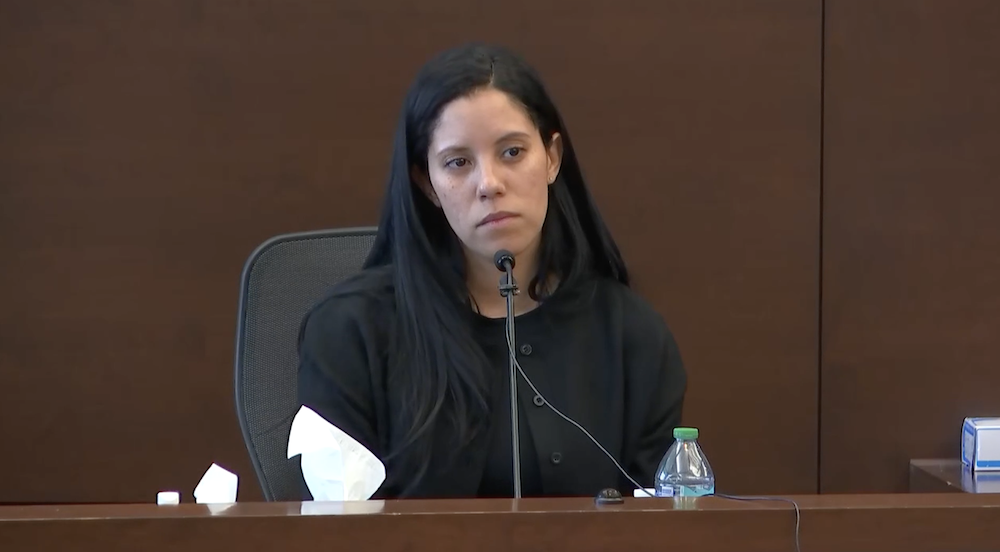
And, for the first time, the court and the public heard from Karena Rosario, Hedgepeth’s roommate, who has been subject to considerable speculation since Hedgepeth’s killing. She was called as the second witness for the state after 33-year-old Alexis Evans, Hedgepeth’s niece.
“Faith was super bubbly. She was the kindest soul…She just had this way about making you feel comfortable with her, easy to open up to, easy to love, just an easy friend,” Rosario said in her testimony.

Rosario found Hedgepeth, a University of North Carolina student from Hollister, N.C., dead in her apartment on Old Chapel Hill Rd. in Durham on Sept. 7, 2012. After nine years of ongoing investigation, police arrested and charged Durham resident Miguel Salguero-Olivares based on DNA evidence. Salguero-Olivares is pleading not guilty to murder, burglary, sexual assault and rape.
Defense attorneys and the public alike have highlighted inconsistencies in Rosario’s account of the events leading up to Hedgepeth’s death. In a pretrial hearing last month, Judge Keith Gregory ruled that defense attorneys could not present evidence arguing Rosario’s guilt.
For the state, this case is simple, argued Assistant District Attorney Angela Garcia-Lamarca in her 18-minute opening statement.
“The evidence is loud and clear and if you listen to it, you will hear and you will be fully satisfied that you know the truth. The simple truth. That the defendant Miguel Salguero-Olivares is guilty,” Garcia-Lamarca told the jury.
She stressed the DNA evidence that investigators collected from the crime scene and later connected to Salguero-Olivares. She said Salguero-Olivares left his DNA inside Hedgepeth’s body and on her boxer shorts, as well as on a blue Riesling wine bottle and a Bacardi rum bottle, the presumed murder weapon. He was a stranger to Hedgepeth and committed the crimes in “a fit of rage,” according to the prosecution.
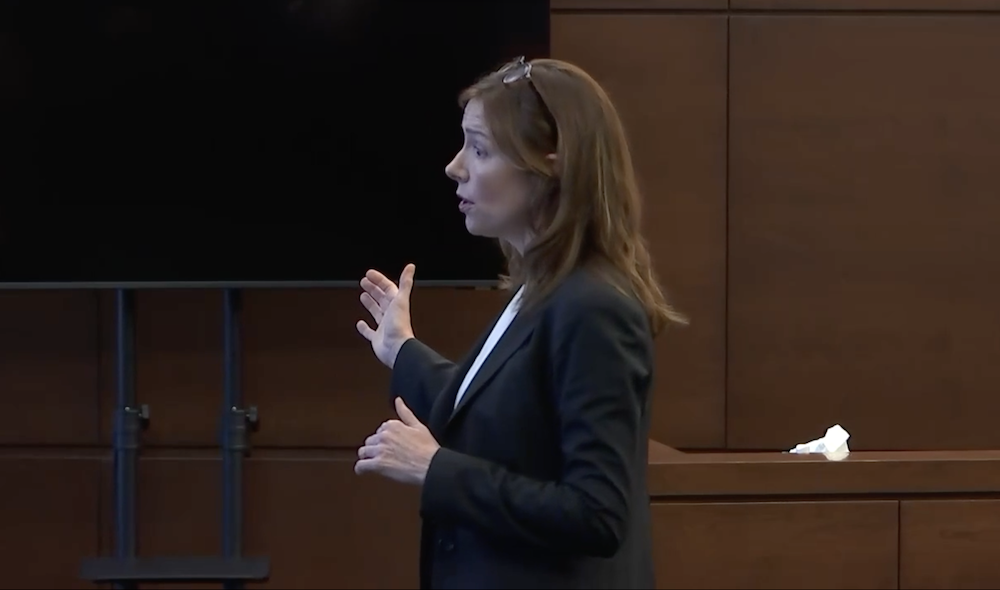
Garcia-Lamarca also revealed a new detail about the case connecting Salguero-Olivares to Hedgepeth’s apartment complex, Hawthorne at the View.
After moving to the U.S. from Guatemala in 2010, Salguero-Olivares briefly worked at Outback Steakhouse in Durham with a number of his family members, many of whom lived at Hawthorne at the View. On the night of the murder, the group had a cookout from 6 p.m. until 5 a.m. near where Hedgepeth parked her car, Garcia-Lamarca said.
However, defense attorney James Rainsford cast doubt on this narrative, along with many other parts of the state’s account, in a statement that lasted 40 minutes.
According to Rainsford, cell records do not place Salguero-Olivares at the barbecue that night, and neither do State Bureau of Investigation interviews with people who were there. As recently as a month ago, these attendees told investigators that Salguero-Olivares had not been there, Rainsford said.
While Garcia-Lamarca leaned on DNA evidence, Rainsford pushed back on its reliability, and he distinguished between testing for a likelihood and a DNA match.
“When you hear his DNA was on the bottle, sometimes it creates the sense of ‘Oh we’ve got a match.’ That’s not even close to what it is,” he told the jury.
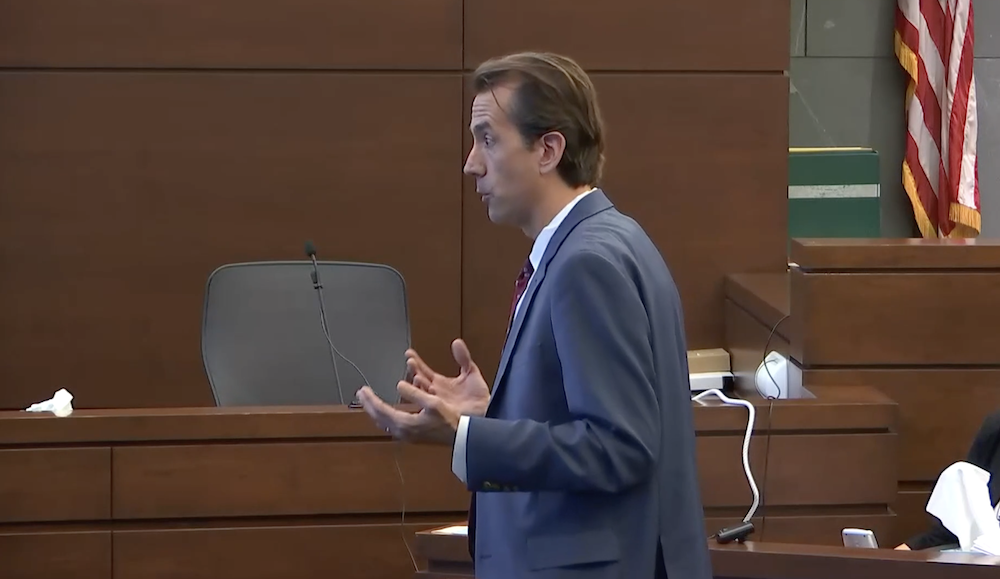
He also wondered aloud about certain DNA samples that the police lost or failed to test, including a red stain on the bathroom doorframe in the apartment. He raised questions about Rosario’s account of events and the 911 call recording, in a similar narrative to the one he delivered at the pretrial hearing.
But when Rosario appeared in court that afternoon, she reaffirmed the account she had given to police in the days following Hedgepeth’s killing — the state even gave each juror a copy to read of her full handwritten statement from Sept. 8, 2012.
Rosario now works remotely in healthcare and lives in New Jersey, where she grew up. Soon after she took the stand Wednesday, she was already wiping away tears.
She told Assistant District Attorney Lisa Coltrain that Hedgepeth had been her best friend since their first year at UNC. They had gone on trips together and lived together before, she said, and they remained close.
In the summer of 2012, Rosario’s ex-boyfriend moved out of her apartment because the relationship had become abusive, she said. Then Hedgepeth moved in, and the two shared one bedroom and one bathroom.
“At that point, it felt like she was like a sister to me,” Rosario said.
Rosario gave the court insight into the early morning of Sept. 7 while she and Hedgepeth were at local nightclub The Thrill, beyond what has been reported by investigators. She recalled seeing a family member of her ex-boyfriend along with another friend with whom she had been romantically involved. After conversations with both men, she remembered being quite intoxicated by the time she and Hedgepeth returned home. She described a sense of extreme emotional turmoil, mentioning that she had just gotten an abortion the week before. She recalled vomiting in her bedroom and then bathroom once they got home.
“I felt like my life was out of control. I was super emotional…I wasn’t sure how I had gotten myself to this point,” she said about the moment.
She confirmed that she stayed in the bathroom alone and texted another friend, Jordan McCrary, to pick her up. When he arrived, she left with nothing except her phone.
To answer one of the many question marks in the case, she explained that she left the apartment door unlocked because they only had one key to the apartment, and she wanted to leave it with Hedgepeth. She also remembered calling 911 the next morning, and she said it was her voice on the call recording. She testified that she has spoken with police on countless occasions, and even kept the same phone number she had in 2012 to ensure that police could reach her if needed.
“I wanted to be helpful and I wanted to know what happened,” she said.
As the testimony and the day drew toward a close, Coltrain asked Rosario three questions: Did she know the defendant, did she know if he was ever in her apartment, or did Faith ever mention anyone named Miguel. Rosario responded no to all three.
The defense will begin its cross-examination of Rosario Thursday morning.
Photo at top: Karena Rosario testifies in court. Pool photo
Sophie Endrud