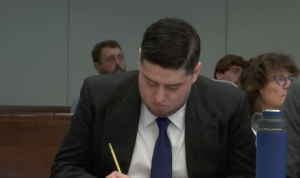
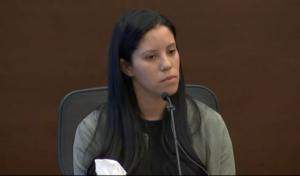
In a hearing Monday ahead of the trial for Faith Hedgepeth’s accused killer, a Durham County judge decided the defense cannot implicate Karena Rosario, Hedgepeth’s roommate, in its arguments.
Amid increased scrutiny of Rosario, the state filed a motion in July seeking to limit the defense’s ability to present evidence regarding the guilt of a third party. Rosario has not been charged in the case.
Attorneys representing defendant Miguel Salguero-Olivares spent nearly three hours in the pre-trial hearing showing photos from the crime scene and recorded interviews with law enforcement.
But Judge Keith Gregory ultimately sided with the State of North Carolina, ruling that despite the evidence against Rosario, the defense could not adequately prove that Salguero-Olivares had not been involved. Both points are necessary to allow a case blaming a third party, and Gregory said he would not “fall for inference and conjecture.”
Hedgepeth, a 19-year-old student at the University of North Carolina at Chapel Hill, was found beaten to death in her apartment on Old Chapel Hill Road in Durham on Sept. 7, 2012. Rosario reported the incident in a 911 call around 11 a.m.
Nine years later, law enforcement arrested Salguero-Olivares in 2021 for driving while impaired. By analyzing his DNA against evidence found on Hedgepeth’s body and at the crime scene, officials later charged him with her murder, along with burglary, sexual assault and rape.
“It’s a relief that we’re finally going to trial,” said Roland Hedgepeth, Faith’s father, in an interview at the courthouse.
“I’m just glad that I’m still alive, so far, to see it. On the other hand, I’m dreading it because of all the emotions and stuff that are going to come out of it. … In the end, we just want the person who’s responsible to be held accountable,” he said.

Salguero-Olivares, 33, is pleading not guilty to all charges. He appeared in the courtroom Monday in an orange jumpsuit, wearing a surgical mask. As his attorney James Rainsford pointed out, he would have been 19 years old during the alleged murder.
“Things get flashed on the news and all you see is someone’s mugshot. It’s so easy to forget this is who’s being accused. It’s a 19-year-old, it’s a kid,” Rainsford said, showing pictures of Salguero-Olivares in 2012 and 2013.
Rainsford reminded the court of the timeline that night, according to witness accounts: Hedgepeth and Rosario first went to Davis Library at UNC from around 8 p.m. until midnight. They went back to their apartment and left at about 1 a.m. to go to local club The Thrill. They returned home in Hedgepeth’s car before 3 a.m.
Once they got back to their apartment, Rosario claimed to law enforcement that she had consumed too much alcohol and was throwing up in their shared bedroom before moving to the bathroom. She said she didn’t move again until she was picked up by a friend, Jordan McCrary, around 4:30 a.m.
Rainsford raised several inconsistencies in Rosario’s account of the night.
First, McCrary told police in a voicemail on Sept. 7 that Rosario had blood on her right hand, of unknown origin, when she got in his car. McCrary told investigators that the two had discussed the blood. But in subsequent interviews, Rosario said she didn’t remember the conversation, and she later said her vomit must have been red.
Rainsford suggested that any blood on her hand may have been linked to additional red staining around the bathroom sink, on the doorframe in the bathroom, and on the passenger side door of the car McCrary was driving that night. However, these samples came to inconclusive DNA results or were not tested at all.
There were also spots on the shirt and denim shorts that Rosario was wearing. She told police repeatedly in interviews that she had left the shirt, a cream tube top with black polka dots, in McCrary’s room in the morning.
In fact, investigators actually found the shirt on her own bed, inside of the crime scene. Yet, testing of the spots on it came back inconclusive.
“These are a lot of strange things happening around the time that you were the last person to see someone alive,” Rainsford said.
Rainsford then raised the possibility that Rosario sent the final texts from Hedgepeth’s phone. In particular, he doubted that Hedgepeth would have texted Rosario’s ex-boyfriend Brandon Edwards at 3:40 a.m., just 83 seconds after Rosario had texted Edwards at 3:30 a.m. Rosario also used similar language to the text sent from Hedgepeth’s phone in a subsequent police interview. But swabs of the phone, albeit limited, did not reveal Rosario’s DNA.
“There’s no evidence to show that Karena used Faith’s phone and sent text messages. That’s an inference. There’s no evidence,” Judge Gregory said.
Both the judge and prosecutors also disputed the defense’s claims that Rosario acted strangely at the funeral and that her use of the phrase “I’m not stupid” in police interviews meant that she had written the same message on a takeout bag found near the body.
Lisa Coltrain, one of the prosecutors assigned to the case, said nothing in the presentation could contradict the fact that DNA linked to Salguero-Olivares was found inside Hedgepeth’s body, on the takeout bag and on a liquor bottle, which police believe may have been the murder weapon. His fingerprints were also at the crime scene.
In steadfast agreement, Gregory decided that the defense cannot use the evidence raised to try to shift guilt to Rosario. That said, he will allow some details from the investigation to be mentioned, including the red spot on Rosario’s finger, the blood found in McCrary’s car and on the bathroom doorframe, the placement of Rosario’s shirt at the crime scene, and testimony from a downstairs neighbor about loud “thumps” she heard that night.
The trial begins next week, with jury selection starting Sept. 28.
Sophie Endrud