5:00 p.m. — Prosecution calls Chapel Hill Police investigators to testify
Right after lunch break, the prosecution called Bryan Walker, who was a criminal investigator with the Chapel Hill Police Department at the time of Hedgepeth’s death. He testified that he specializes in cell phone and computer forensics, and that he did cell phone extractions on phones belonging to Hedgepeth and her roommate, Karena Rosario.
Then, for more than an hour, the court watched a recorded video interview that Chapel Hill Police conducted with Rosario shortly after Hedgepeth’s death. As The 9th Street Journal previously reported, Rosario has been the subject of intense scrutiny, including by Salguero-Olivares’ defense attorneys.
In that video, Rosario detailed the evening and early morning hours leading up to Hedgepeth’s death, as she did when she took the stand last week during the trial. She told the CHPD investigator how the two went to the library, then to a nightclub, before returning home. Rosario explained how she was drunk and vomiting in their bathroom, and then left the apartment around 4 a.m. to go stay at a friend’s house. Rosario recounted coming back to their apartment around 11 a.m., finding Hedgepeth’s body, and calling 911. She also talked about her close relationship with Hedgepeth.
With few questions, Walker was then excused from the courtroom and released from his subpoena.
The prosecution then called Capt. Johnnie Britt, who was the lead CHPD investigator on the Hedgepeth case for two years. She was among the first officers to arrive to the crime scene.
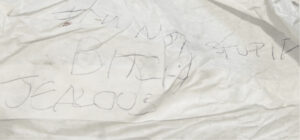
She mentioned finding a white takeout bag on the bed, and that it was notably out of place, despite the apartment being “really messy.” That bag, which has since become one of the most talked-about pieces of evidence in the case, had a note written on it reading: “I’M NOT STUPID BITCH JEALOUS.”
Capt. Britt testified that, about two to three weeks after the murder, lab information was returned to investigators identifying an unknown male DNA profile that was present in vaginal and anal swabs of Hedgepeth’s body as well as on objects at the crime scene.
Assistant District Attorney Angela Garcia-Lamarca asked Britt how investigators tried to find that person.
She said officers went through Hedgepeth’s phone contacts, and considered who she had recently seen.
“She worked at Red Robin,” Britt said. “So we explored men in all of those places, including people who lived at the apartment complex or would have lived there at the time of this crime.”
She said over the course of roughly two years, investigators questioned hundreds of people and asked them to provide DNA, ultimately collecting roughly 300 samples.
In cross-examination, defense attorney James Rainsford became frustrated when Britt did not know the answer to his question about how many officers had been into the apartment during the course of the investigation. Rainsford said “crime scene integrity” had been in question before. Britt replied that she had reviewed hundreds of pages of documents prior to coming to testify, and she could not recall everything.
He also pressed Britt on why no swabs were taken from the gas cap of Hedgepeth’s car, which was noted to have been found open, and why swabs that were taken from the apartment doorknob were never tested.
“I do not have an answer for that,” she said.
At 4:57 p.m., the judge paused Rainsford’s questioning of Britt, which will continue tomorrow.
Court is now in recess until 9:30 a.m. tomorrow morning.
–Sarah Krueger, Managing Editor
11:20 a.m. — It’s Monday, Oct. 12 — the 11th day of trial for the man accused of killing UNC student Faith Hedgepeth in 2012. Miguel Salguero-Olivares is charged with murder, burglary and rape.
The first witness called by the prosecution, just after 10 a.m., was Heather Waleski, a family nurse practitioner and sexual assault nurse examiner. While she did not examine Hedgepeth, she told the court she has performed “thousands” of sexual assault exams during her career.
Prosecutors asked her how long DNA can remain after a sexual encounter. She said while medical professionals previously believed a sexual assault exam must be done within three days, a 2014 medical study’s findings widened that window to five days.
During cross-examination, defense attorney James Rainsford emphasized the amount of time DNA can remain after sexual intercourse, noting that the 2014 study states DNA detection was greater than 50% even 10 days later.
“I can’t determine the timing when [DNA] was deposited,” Waleski said, adding that “there is the potential” it was several days prior.
Rainsford also pressed her about how the presence of sperm does not mean sex was nonconsensual.
“If you recover sperm on a sample, that doesn’t mean that a sexual assault occurred, correct?,” he asked.
“Correct,” she replied.
The medical examiner testified Friday that no injuries were observed in Hedgepeth’s genital area. While the defense has returned to this point on multiple occasions, Waleski reiterated today that “it is quite often that, depending on the history the patient has given, that we may not find injuries,” adding that injuries are typically only present in 20-40% of sexual assault cases.
Waleski said she is unable, in any case, to definitively state if a sexual assault occurred.
“You can have injuries with a sexual assault, and you can not have injuries and a sexual assault still has occurred,” she said. “I can’t say whether an assault has happened or not.”
Waleski finished her testimony at 11:09 a.m. and was released from her subpoena, meaning she will not be called to testify again in this trial.
Court is in recess until 11:25 a.m.
–Sarah Krueger, Managing Editor
9th Street Journal Staff