11:25 a.m. — Witness testifies on DNA evidence linking Salguero-Olivares to crime scene
It’s Thursday, Oct. 15 — the 14th day of trial for the man accused of killing UNC student Faith Hedgepeth in 2012. Miguel Salguero-Olivares is charged with murder, burglary and rape.
This morning, the prosecution reached a major milestone in the case, hearing testimony from a scientist whose analysis links Salguero-Olivares’ DNA profile to the crime scene.
On her testing of sperm from a rectal swab taken from Hedgepeth’s body, the DNA mixture found “is approximately 170 septillion times more likely if it originated from Faith Hedgepeth and Miguel Enrique Salguero-Olivares” than from Hedgepeth and an unknown male. A septillion is a one followed by 26 zeros, she explained.
On her testing of a DNA mixture found on vaginal swabs taken from Hedgepeth’s body, she said it is 114 septillion times more likely to be from Hedgepeth and Salguero-Olivares than Hedgepeth and someone else.
On her testing of the top of the Bacardi rum bottle that police believe was the murder weapon, Ermish said it is “approximately 48.6 tredecillion” times more likely to be DNA from Hedgepeth and Salguero-Olivares than DNA from two unknown contributors. A tredecillion is a one followed by 42 zeros.
Ermish said the “likelihood ratio statistic” in DNA testing has been used by the state’s crime lab since 2020, when it switched to a newer software program for DNA interpretation.
–Sarah Krueger, Managing Editor
5:00 p.m. — Defense cross examines witness on validity of DNA evidence
Defense attorney James Rainsford continued to raise doubt on Thursday afternoon around the process of DNA collection and testing that linked defendant Miguel Salguero-Olivares to the crime scene of Faith Hedgepeth’s 2012 killing.
Throughout the morning, the prosecution questioned Erin Ermish, a scientist from the state’s crime lab. She explained the statistical process behind determining the likelihood that a sample is a certain person’s DNA profile.
In more than two hours of cross examination, Rainsford asked Ermish why some items from the crime scene were tested for DNA and others were not, and pressed her on how she selected what part of each item to swab. For example, the lab had collected samples from the buttons and sides of Hedgepeth’s cell phone, but not the screen or the back. Ermish said she tried to avoid swabbing smooth surfaces for DNA analysis.
Rainsford also inquired about DNA swabs taken of what was believed to be blood in the Lexus car that Hedgepeth’s roommate Karena Rosario rode in on the morning Hedgepeth was found dead. He also asked about the top and jean shorts Rosario wore early that morning.
Ermish confirmed that the swab collected from the Lexus had DNA in it, just not enough to make a profile. She testified that after swabbing the entire outside layer of the polka-dotted tube top Rosario was wearing, she found DNA to be present from more than one person, but she did not find a sufficient amount for interpretation. The jean shorts were also inconclusive, and Rainsford asked why she did not test a specific stain that could be seen in a picture of the shorts.
“I chose another area on the same side of the jean shorts that I thought would be a better sample to take forward for DNA analysis,” Ermish replied.
Rainsford pressed on about the “likelihood ratios” Ermish used to test for DNA profiles. Ermish explained that the ratios were based on three population groups: Caucasian, African-American and Hispanic, without accounting for sub-populations.
“We use those for statistics because they are the three most common population groups in North Carolina,” she later told Assistant District Attorney Angela Garcia-Lamarca.
She said the lab did not analyze the hair, pillows, bedsheets or comforter found in the apartment. Rainsford has repeatedly highlighted doorknobs and light switches as other areas that went untested.
In response to follow-up questioning from Garcia-Lamarca, Ermish revealed that the crime lab typically does not test these surfaces because they don’t yield good results, and scientists would need to eliminate standards from everyone who could’ve touched them in normal circumstances.
During the afternoon break, one juror asked a sheriff’s deputy for an update on the total length of the trial. He relayed the message to the judge, who reiterated the court’s initial estimate that the trial would last five to six weeks.
“You’ve remained attentive, alert…and I know that you are taking this seriously,” Judge Keith Gregory said, thanking the jury for their commitment. “We’re going at a good pace.”
Since the day concluded with renewed questioning from the prosecution, the defense will proceed with re-cross examination of Ermish tomorrow.
–SOPHIE ENDRUD
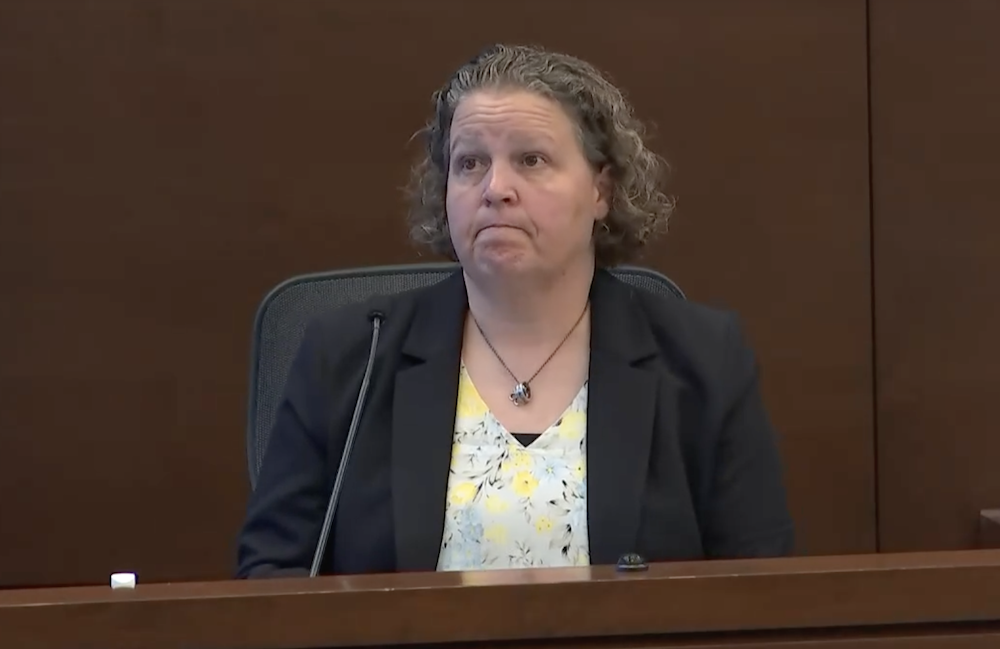
Photo at top: Erin Ermish is a forensic scientist at the North Carolina State Crime Laboratory, focusing on DNA found in bodily fluids. Pool photo
9th Street Journal Staff