Durham Public Schools is requesting an ambitious increase of $28.5 million in county funding for the 2026-27 school year, with more than $10.5 million earmarked to support a classified staff pay increase of just over 12%.
The budget proposal, which calls for a total of $252.5 million in county funding (including $7.8 million in capital outlay), passed unanimously at a school board meeting on Thursday night. Now significant hurdles lie ahead as the budget awaits approval from the county.
“Last year, we requested a little over $16 million, we got a little over $12 [million],” said Jeremy Teetor, the district’s chief finance officer. “We had to work with the board to…reprioritize.”
A previous version of the proposal faced vocal pushback from workers who said a 5% increase in classified pay was not enough. The current proposal would bring their pay in line with the county minimum wage of $19.22 per hour.
In addition to pay increases, the proposal includes $2.8 million to replace outdated school technology, including Chromebooks and interactive screen displays called BrightLink panels. This marks a substantial reduction from the $3.7 million originally allocated towards classroom technology, a sum that community members questioned at a town hall in February.
Opinion on funding classroom technology remains split among community members and the school board.
On Thursday, Lina Nealon, a mother of DPS students and the director of strategic partnerships at the Institute for Families and Technology, urged the board to redirect the $2.8 million away from classroom technology and towards staff pay and building maintenance.
“These tech platforms are not educating. They are endangering [students],” she said.
Others stressed the need to prepare students with the tools — and the tech — necessary for the future. “How do we expect students to be able to compete in the 21st century if we’re not giving them those tools?” said Board Chair Bettina Umstead.
Elizabeth Leathers, an eleventh-grader, said she and her peers would welcome updated technology in their classrooms at J.D. Clement Early College High School. “When the projector malfunctions, it’s a whole thing…,” she said. “It would be nice if we got some newer things.”
In the upcoming school year, the district must contend with a reduction of $7.2 million in state funding due mostly to declining public school enrollment, not to mention $6.6 million lost to charter schools.
The district can expect budget recommendations from the Durham county manager in May, Teetor said at the meeting. County commissioners will make a final decision on the district’s local funding on June 8.
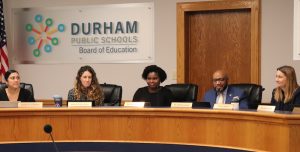
Above (from left): School board member Millicent Rogers, Superintendent Anthony Lewis and board member Natalie Beyer listen to comments at a school board meeting earlier this year. Photo by Reece MacKinney — The 9th Street Journal
Tanya Wan