Durham school administrators’ proposal to demolish three elementary schools and reassign those students has families and community members worried.
“It’s really a bitter pill to swallow, because Club is a neighborhood-based school,” Theresa Dowell Blackinton, a parent at Club Boulevard Elementary School, said in an interview with The Ninth Street Journal. “So many of our kids walk, ride their bikes, go over to Northgate Park after school to hang out…
“If you move the campus to DSA, we lose all of that.”
The proposal calls for demolishing Club Boulevard and George Watts elementaries and consolidating both schools at what is now the site of Durham School of the Arts. Under the plan, the district would also demolish Y.E. Smith and reassign its students to an expanded Eastway Elementary. Twelve other schools have been placed on a watch list for future consolidation or “trading up,” administrators said at a March 10 meeting.
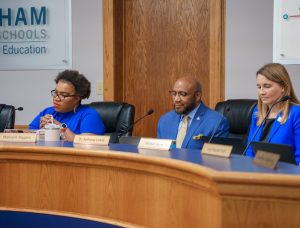
“No decisions have been made final,” Superintendent Anthony Lewis stressed at the joint meeting of the school board and county commissioners.

The proposal comes as the district stares down nearly $1 billion in projected building maintenance costs, along with declining enrollment. If the plan is approved, administrators hope to hold a bond referendum in November 2026 and select a designer for the consolidated schools by the end of 2027.
Administrators emphasized the preliminary nature of the proposal in an emailed statement to The 9th Street Journal.
“The recent report [on consolidated schools]…was intended to provide a school planning update that included examples of facility consolidation,” wrote district spokesperson Crystal Roberts. “As this report was only an illustration and not presented as a formal recommendation, the actual process of consolidation would require community input and Board of Education approval.”
At the meeting, school planning director Devan Mitchell said the proposed changes –– under the district’s capital improvement plan –– could bring about “a number of efficiencies and benefits.”
“Both of these schools are 75-plus years old,” Mitchell said of Club Boulevard and George Watts. “They’ve had four to five modernization and improvements and they still continue to be in poor shape in terms of maintenance and repairs.”
“The cost to repair versus cost to replace doesn’t make good financial sense,” she added.
Smaller schools: A plus or a minus?
Yet some community members caution that closing the smaller schools could have other costs. That includes retired planner John Hodges-Copple.
“Absent clear evidence that smaller, urban schools have poor outcomes and cost significantly more to operate than the alternatives, we shouldn’t start hastily down a path that could close or consolidate them, and lead to further enrollment declines,” Hodges-Copple wrote in a statement shared with board members.
In addition to maintenance costs, Mitchell referenced elementary school enrollment and site acreage as reasons to demolish and consolidate elementary schools.
Elementary schools on sites of less than 10 acres or enrolling fewer than 450 students –– the case for many schools on the district’s watch list –– are not “adequately sized” based on state guidelines, Mitchell said. She recommended “taking incremental steps to put these schools in line with a 700-800 student school, which is our district standard.”
A look at the state’s facilities guidelines suggests problems with the acreage and size statements, however.
State facilities guidelines recommend a minimum of 10 acres specifically for schools in a “rural or suburban area with a one-story building,” among other key conditions. The guidelines state that schools located in urban areas “may find creative solutions on substantially smaller sites.”
All three of the elementary schools slated for potential demolition are located in urban settings. Two of them –– George Watts and Y.E. Smith –– feature buildings more than one story high.
State guidelines about elementary school size are also more nuanced. The guidelines do recommend an ideal elementary school membership size of 450-700 students. However, they also state that an elementary school enrollment of 300-400 students is permissible, and they acknowledge research that indicates a “positive relationship between smaller school size and…school climate and order.”
George Watts, Y.E. Smith, and Eastway elementary schools each enroll between 310 and 370 students.
“Each local board of education must ultimately determine school sizes that best serve their purposes,” the state document said.
Community members push back
Parents and community members say they’re worried about the preliminary plans.
Paige Prather, the mother of a pre-K student at George Watts and a former teacher at DSA, highlighted the potential pitfalls of consolidating elementary schools.
“Closing and consolidating greatly disrupts community-building,” Prather said in an interview. “And I personally feel that it will only hurt the [district’s] enrollment issue, as families with privilege and mobility will choose to go elsewhere.”
In an interview, Hodges-Copple, the retired planning director, said administrators are making the same faulty arguments about cost previously made in favor of building a new Durham School of the Arts rather than renovating the school.
When the district decided to build a new DSA rather than renovate the school, administrators cited cost as a key reason. Frederick Davis, the former senior executive director of building services, stated that building a new arts school would cost $240 million, and that renovating the old school would cost the same. The group Durham for DSA responded with a proposal to renovate the property for just $180 million.
The new arts school is costing far more than original projections, however. According to the most recent estimates available — last updated in 2024 — building the new school will cost roughly $256 million, making the new DSA among the most expensive middle or high schools in the state.
“The problem with DSA was, the costs [of building a new school] were far higher than what they took to the voters in 2022…,” said Hodges-Copple. “We thought they were way overestimating the comparative renovation-expansion costs. Now, it’s a pyrrhic victory [for us].”
Hodges-Copple said the district risks underestimating the cost of consolidating elementary schools, as it underestimated the price of building a new DSA.
“My guess is that, for the most part, renovation would compare favorably [to consolidation],” he said.
Hodges-Copple questioned the logic of consolidating Club Boulevard and George Watts elementary schools onto the site of the old DSA campus, a former secondary school that lacks necessary amenities such as elementary school playgrounds.
George Watts and Club Boulevard also have very different academic approaches. Unlike Club Boulevard, George Watts is a Montessori school; Club Boulevard hosts a dual language (English and Spanish) immersion program that George Watts lacks.
The district is exploring a potential bond referendum for November that may include the elementary school demolition and consolidation. Yet many district building projects approved in the 2022 bond referendum remain incomplete.
“The school system has always had trouble getting things done,” Hodges-Copple said, pointing to the district dashboard tracking the progress of construction projects voters included in the 2022 bond referendum.
According to the dashboard, over 96% of the $624.2 million dollars approved has yet to be committed. The dashboard, last updated in late 2024, is slated to be updated by May 30, according to a district spokesperson.
One school slated for renovations under the 2022 bond referendum is Club Boulevard, which administrators now seek to demolish. According to the dashboard, $548,227 has been spent on designs for Club Boulevard.
Blackinton, the Club Boulevard parent, urged the district to prioritize community feedback as it weighs the proposal.
“I know the district has to make tough decisions with falling enrollment and a serious lack of funding…but they have a history of just blowing off parents’ concerns and that leads to this decline in enrollment,” she said.
“Having an open and honest conversation with families would be the first step.”
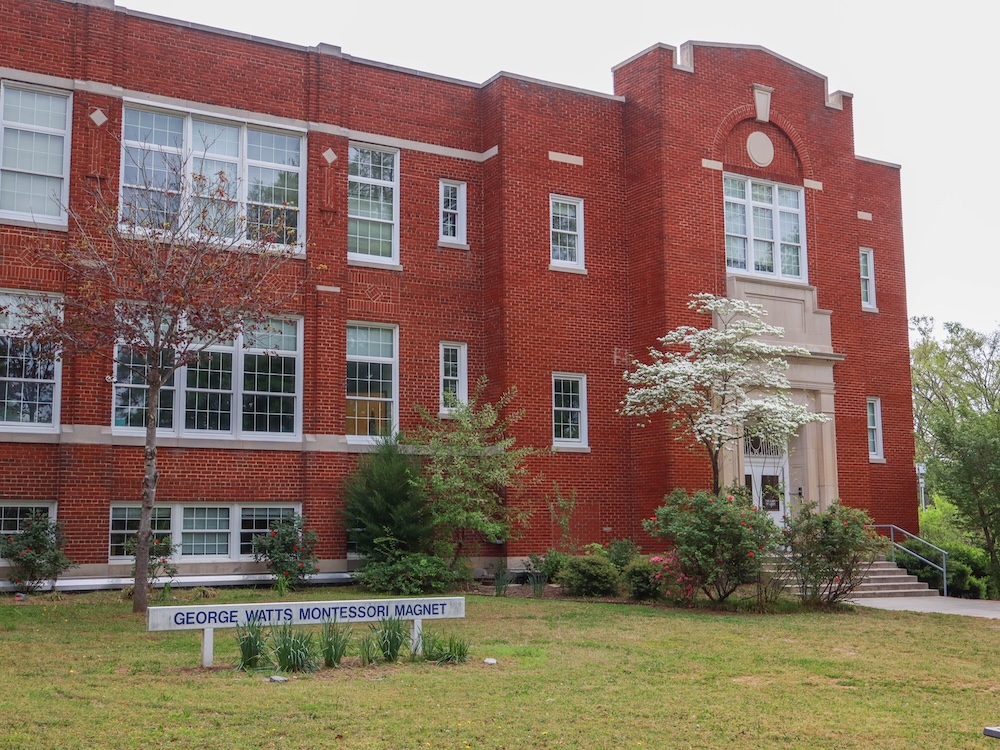
Above: Photo of George Watts Montessori Elementary School by Lena Nguyen — The 9th Street Journal
Tanya Wan