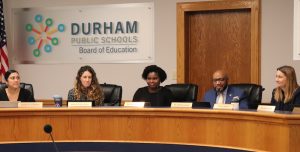
At a budget town hall on Monday, Superintendent Anthony Lewis looked up at a word cloud of community feedback projected across screens. In the center of the screens, two words loomed larger than all the others: “pay” and “staff.”
The feedback was “loud and clear,” Lewis said.
Staff pay was a consistent theme of public comments at the town hall, where administrators shared a mix of good and bad news about the district’s finances.
On the positive side, the school system’s fund balance, which had been in decline since 2022, is recovering. The district drew heavily on those monies — intended as an emergency fund — to cover salaries during the pay crisis two years ago. Last year, the district added more than $3 million back to the fund balance, Jeremy Teetor, the district’s chief finance officer, told the crowd.
However, charter school growth in Durham, which has already cost the district millions, shows no sign of stopping. Two new charter schools are slated to open this August with an estimated initial enrollment of 1,000 students, Teetor said. As a result, another $6.6 million of local dollars must be diverted to charter schools in Durham. “The money follows the students,” Teetor said.
The loss of funding corresponds to a loss of around 61 classroom teachers, which the district hopes to absorb through reassignment and attrition.
Changing federal visa policies are also hitting the district, limiting its ability to hire international teachers. Employers now must pay a $100,000 application fee in order to hire international teachers using the H-1B visa. In response, the district will limit international hires that require H-1B visas, the superintendent said.
The district plans to increase certified and classified workers’ pay by 5%, Teetor said. One community member called the increase insufficient, noting that board policy states that hourly workers’ pay should increase in line with the county’s minimum wage.
“We’re not there yet,” Superintendent Lewis said, acknowledging the mismatch between the budget plans and board policy. “We’re not happy about it…but we are feverishly working towards that with the funds that we do have [to] address our classified staff wages.”
The town hall was intended to increase transparency about the district’s finances and featured detailed comments by Teetor, the district’s chief finance officer. When he introduced himself, audience members cheered in approval.
Teetor, hired in 2024 shortly after Lewis was appointed superintendent, has been digging deeply into the district’s finances since. He has worked closely with the superintendent to tackle budget issues, conducting extensive financial audits and revamping the district’s accounting system.
“I’m concerned this [information] might come across as boring,” Teetor said as he began his presentation, “but [a colleague] assured me that the folks in the room have been waiting to see this…level of detail for quite some time.”
He then launched into a breakdown of the district’s $800 million budget by funding sources, expenses, and more. Capital outlay funds, mostly from bonds, make up around a third of the budget. Local and state funds comprise 27% and 30%, respectively, while federal funds account for just 4%.
The district manages 37 different buckets of state funds, each of which come with spending restrictions. “There are a number of things that we cannot pay for from our state funds, and the local sources are the only places where we can do that,” Teetor said.
Local funds cover salaries for certain staff, such as building maintenance workers, in addition to property insurance, auto insurance, and workers’ compensation, among other things.
Excluding capital outlay, the district spends more than half of its overall budget––$292,455,560––on salaries for teachers, staff, and administrators. Around 42% of those funds go to instructional personnel, while operational support and instructional support personnel, combined, take up another 29% of funds.
Recovery of the fund balance has involved two years of financial audits, which have allowed the district to reclaim $3 million for a total balance of $11 million. The district also bailed out certain school system programs in recent years, including loaning $8 million to the child nutrition program. That program will soon be repaying the district in installments, Teetor said.
“We’re pleased to be trending in the right direction,” Teetor said.
County Commissioner Michelle Burton took the podium at one point to address concerns about pay in the school district. “So much of the funding for the schools is supposed to come from the state…,” she said. “This is something we’re going to have conversations about because we want our people to get paid…we’re hearing you clearly about this issue.”
Some community members also questioned how the district chooses to allocate funds.
Rob Fields, a grandparent of three DPS students, voiced doubts about the $3.7 million allocated to replace out-of-warranty student Chromebooks and interactive classroom screen displays called BrightLink panels.
“The concept that more screen time results in less student performance seems to be pretty well-supported by the data,” Fields said. “And if that’s true, do we really need as many computers as we’re buying?”
Despite ongoing concerns, the mood in the town hall was positive.
“It was a very open exchange, [there] seemed to be a lot of receptivity around the ideas people were presenting,” Fields said in an interview after the town hall.
“We’ll see where it goes.”
Above: Durham school board members Millicent Rogers (left) and Natalie Beyer (right) and Superintendent Anthony Lewis (center) listen to public comment at a recent school board meeting. Photo by Reece MacKinney — The 9th Street Journal
Tanya Wan