Over half of Durham Public Schools high schoolers were chronically absent in the first six months of the current school year — yet another challenge for a district already facing state underfunding and declining enrollment.
“In no way are we where we need to be with this data and with our students…,” school board member Natalie Beyer lamented at Thursday’s school board meeting. “This is grim…It’s just embarrassing for Durham to be this egregiously bad.”
Students are deemed chronically absent when they miss school for 10% or more of the academic year, no matter the reason. Missing half a day or more of school counts as one absence. Short-term suspensions are included in the tally but long-term suspensions are not, according to administrators.
By state law, children aged 7 to 16 must attend school, and parents are responsible for their attendance.
While absenteeism rates were highest for high schoolers, absences were also high across all grades. Roughly 37.3% of all students in the district were chronically absent in the first six months of this school year.
Missing students are a relatively new challenge for the district, which saw attendance rates plummet following the pandemic. In 2018-19, 18.8% of students across the district were chronically absent. Since the pandemic, absenteeism rates have remained high, peaking at 40.9% in the 2021-22 school year.
Last year, Durham Public Schools recorded a chronic absenteeism rate of 36.2%, the highest among the state’s 12 largest school districts. This number outstrips rates across the state and nationwide, recorded at around 24.3% and 22% respectively.
School board member Joy Harrell Goff said there are complex reasons why students might miss school.
“We have babies that are staying home taking care of their siblings so their parents can find work,” Harrell Goff said. “When we’re talking about removing barriers, it’s not always just the barrier of [students] choosing not to engage in school.”
The absenteeism numbers reflect stark demographic differences.
“DPS aligns with the national and state trends which consistently show that…historically marginalized student groups experience higher rates of chronic absenteeism than their white peers,” said Laverne Mattocks-Perry, senior executive director of student support services.
Since the 2021-22 school year, over 40% of Black and Hispanic students have been chronically absent from Durham schools, with each group exceeding statewide rates by around 10 percentage points annually.
So far this year, absences among Hispanic students are higher still. Among those students, chronic absenteeism spiked at an eight-year high of 47.2% in the first six months of the school year. Likewise, 52.3% of the district’s English language learner students were chronically absent.
Students with disabilities were also disproportionately affected, with 44.7% of those students chronically absent, up from 23.9% in the 2018-19 school year, before the pandemic.
As part of wider campaign efforts to promote attendance, the district plans on hosting the Greater Durham Attendance Summit this summer.
Beyer argued for a broader community effort.
“Do we need a Durham-wide campaign about this? Representative Morey, some states have done statewide attendance campaigns,” she said, addressing the state legislator sitting in the back of the board room.
State Rep. Marcia Morey, who attended the meeting in a white blazer, nodded.
“I don’t know if that comes from legislation, but — I’m sure they’ll fund it,” Beyer added with a dry chuckle.
Administrators also hope that focusing on restorative practices will help resolve the attendance crisis.
“We want to move from reacting to absences to preventing them early,” said Chanel Sidbury, assistant superintendent for school support and continuous improvement. “That means we need to act within the first few absences instead of letting them stack up.”
The district is working with the Elna B. Spaulding Conflict Resolution Center, a local nonprofit organization, to conduct truancy mediation, a restorative process that brings families and schools together to “identify root causes and create shared, actionable solutions to improve daily attendance,” Mattocks-Perry said.
This year, 132 students were referred to truancy mediation, more than double the number the year before. Of those students, 58 had logged more than 30 absences at the time of referral.
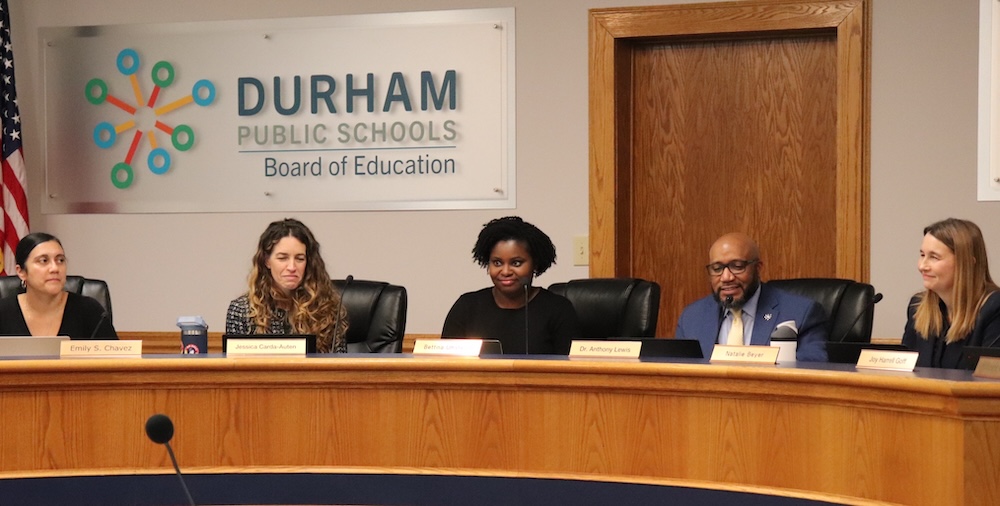
Above (from left): Emily Chavez, Jessica Carda-Auten, Bettina Umstead, Superintendent Anthony Lewis and Natalie Beyer at a previous school board meeting meeting. Photo by Reece MacKinney — The 9th Street Journal
Tanya Wan