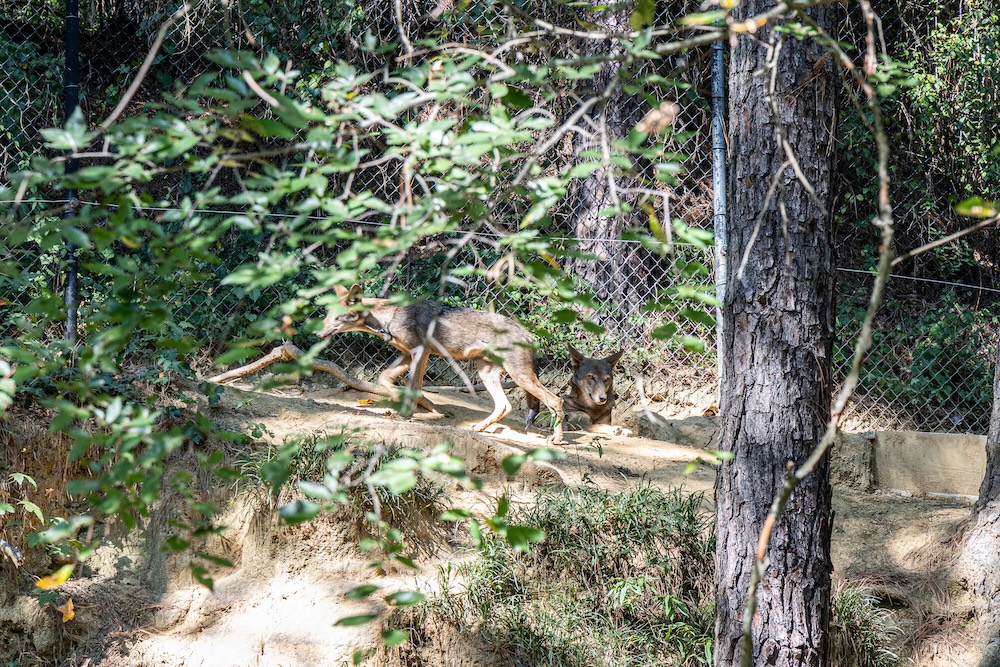
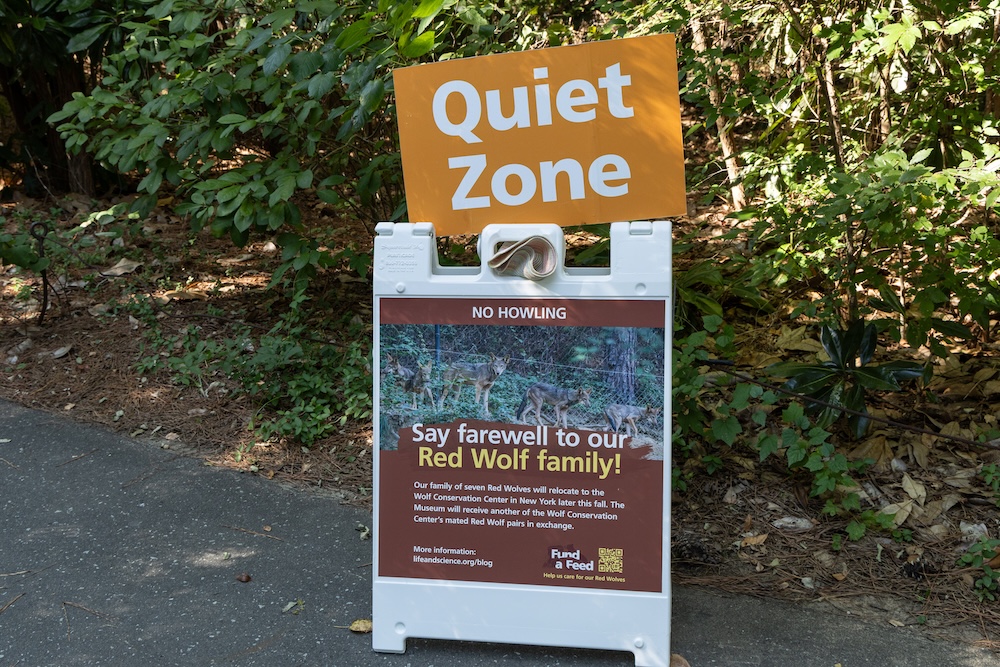
A family of red wolves living at Durham’s Museum of Life and Science is being relocated to the Wolf Conservation Center in South Salem, New York later this month. Museum staff believe this will give the wolves the best opportunity to gain the skills they need to eventually be released into the wild, helping to repopulate the critically endangered species.
In New York, the wolves will be placed into a much larger facility where they will be able to “hunt” for prey more naturally. Because of that, the Wolf Conservation Center is more likely “to have an individual wolf picked to be released to the wild,” according to Sherry Samuels, who has been the senior director of animal care at the museum for more than 30 years.
Parents Carolina and Jaques will depart alongside their 5-month-old pups in the hopes that the pair will produce more red wolves.
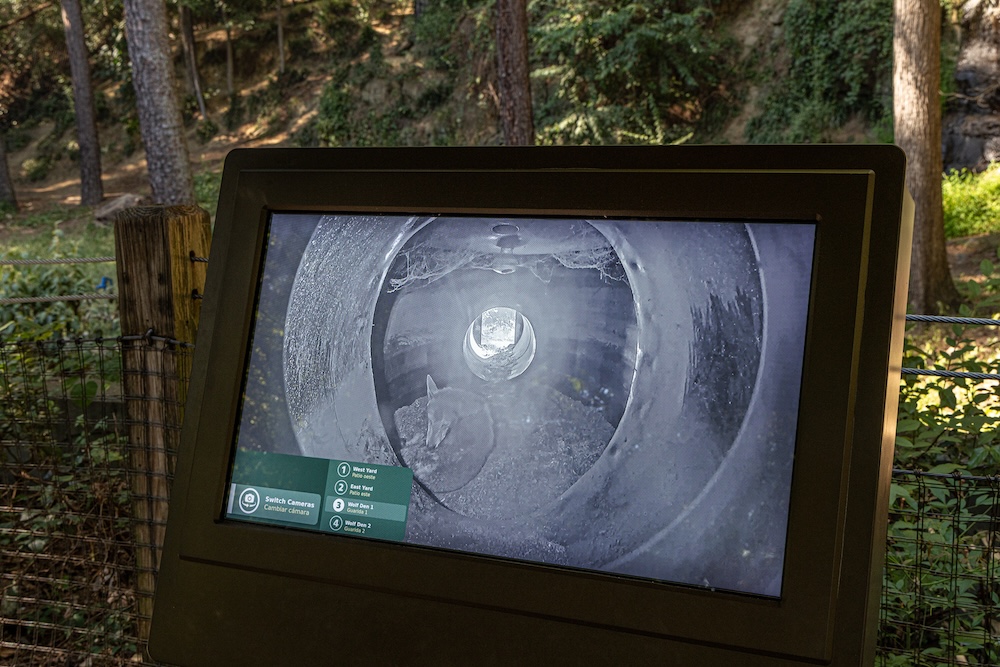
Filling their soon-to-be empty habitat in Durham, potential parents Sabine and Mac Tíre will be transferred from the Wolf Conservation Center to the Museum of Life and Science (MLS). This will be the sixth transfer of wolves between the two institutions.
The exhibit’s signage explains that red wolves used to roam the East Coast from New York to Florida. Now, there are believed to be fewer than 40 in the wild worldwide – all in a five-county area in North Carolina. Government-sponsored hunting and habitat loss have led to red wolves becoming the most endangered species of wolf globally.
MLS had a wolf habitat in the late 1980s that transitioned into being a specific red wolf rehabilitation program in 1992 and has since cared for more than 70 wolves. In 2018, the program became part of the Association of Zoos and Aquariums’ SAFE (Saving Animals From Extinction) program. SAFE has 53 institutions working together to care for the 290 red wolves in the program and the 20-25 currently in the wild.
The ultimate goal of these partnerships and programs is to place and monitor 400 wild red wolves in multiple areas across the state and hopefully the country.
The MLS has over 620,000 visitors annually. For the wolves, that many people passing by can be overwhelming. By the habitat, a sign reads “no howling.” Ranger and Park Naturalist Gregg Dodge explained that visitors get excited and shout out to the wolves. He said the move to the New York facility, which does not allow visitors, will allow Carolina and Jacques to flourish in a more calm environment.
Factors such as low sperm quality, shy dispositions and inbreeding have led to a low repopulation rate, contributing to their endangered status. It is for this reason that the pairings and transfers are important in their mission to repopulate the species.
In the last nine years, six out of the seven breeding pairs at the MLS produced offspring, which Samuels believes is “unheard of.”
“Something’s in the water here!,” she said, jokingly.
Samuels said the high success rate could be attributed to the wolves’ specialized habitat, which was built especially for the wolves’ needs. This is important to encourage reproduction as red wolves are particular breeders, only mating once a year. One important feature is a high ledge at the back of the habitat.
“There’s a sense of power that you get looking down on things,” Samuels said, explaining that allows the wolves to feel in control. “It’s a place of safety.”
At the MLS, animal care staff feed the wolves with launchers called “ratapaults,” each stationed roughly 100 feet away from the habitat. They launch food without humans being visible. This is so the wolves retain their wild instincts and do not associate humans with food.
In fact, the animal care staff only enter the wolves’ area twice a week.
“We’re doing as much as we can to interact with these guys as little as possible,” Samuels said.
SAFE selects breeding pairs that they believe are the best genetic pairs for the long-term success of the species. Given the small population size, it is important to encourage genetic variation by pairing non-related wolves to avoid genetic problems.
Selective breeding is also based on traits noted in the animals, Samuels said, encouraging a quicker process of natural selection to see who is “a better candidate to be released to the wild.” For instance, wolves that repeatedly show interest in visitors at the museum are likely to approach humans in the wild, which could result in danger for both the human and the wolf.
It is for this reason that partnership between institutions across the country is so important. Samuels stressed that “we are part of a bigger picture” and that no institution can fight the threat of extinction alone.
Photo at top — Carolina and Jacques’ litter of five pups was born in May. Photo by Abby Perry — The 9th Street Journal
Gemma Tutton