
The State Board of Elections intended to change its voting rules on Wednesday to better identify noncitizens. But enormous public opposition forced the body to postpone.
“I would like to thank everybody who showed up today because they feel passionate about this issue,” said Board Member Siobhan O’Duffy Millen.
“I feel like you should’ve been given notice yesterday that we were going to postpone this, I think that would’ve been the polite thing to do,” Millen said. “But I welcome that we’re slowing this down.”
The board received more than 15,000 public comments before the comment period ended on March 16, as well as criticism voiced at a lengthy public hearing on March 9. In a brief Wednesday morning meeting, the board decided to allow more time to review all the feedback.
The board has proposed applying the Department of Homeland Security’s Systematic Alien Verification for Entitlements (SAVE) program to N.C. voter rolls. Under the proposal, if the SAVE tool flags an individual as a “presumptive noncitizen,” the county elections board would have five days to determine if that person previously provided documentation of citizenship. If they cannot, the county board sends that person a warning notice by mail and email. A preliminary hearing and formal challenge hearing follow to determine their ability to vote.
The SAVE tool differs from the SAVE America Act, albeit with similar objectives — the Safeguard American Voter Eligibility (SAVE) Act is a federal bill that mandates proof of citizenship in voter registration.
“This is not the SAVE Act…this is a SAVE tool that is used to verify if a person is an alien or not,” Millen said.
Still, nonprofit voting rights organizations are concerned about the tool’s potential for inaccuracy.
The SAVE system was originally set up in the 1980s under the Immigration Reform Act to determine eligibility for federal benefits based on Department of Homeland Security records of immigration status, said Michelle Kanter Cohen, policy director and senior counsel at the Fair Elections Center. In 2025, DHS overhauled the system to include social security records and to use a “bulk upload” of names rather than looking each person up one by one, Cohen said.
“Those 2025 changes…raise the risk for incorrect information and unreliable information about citizenship being used to maintain the voter rolls,” she said.
In a December letter to the State Board of Elections, the Fair Elections Center and the Southern Coalition for Social Justice outlined these concerns. The state board previously used the SAVE tool to check the citizenship of naturalized citizens and their children, when the tool only contained DHS data. However, a state audit of the 2016 general election in North Carolina concluded that “a match with the SAVE database is not a reliable indicator that a person is not a U.S. citizen,” the letter notes.
The database was not regularly updated, the audit said, and “individuals who derived citizenship from their parents through naturalization or adoption may show up as non-citizens in SAVE.” Even after proving U.S. citizenship in follow-up interviews, three-quarters of those flagged continued to appear as noncitizens in the database, the audit found.
Now, under the proposed new voting procedures, state and local election officials would use SAVE to confirm the citizenship of all voters using their Social Security numbers. The December letter also warns that Social Security Administration citizenship data can be inaccurate, since it only represents an individual’s citizenship status at the time of their interaction with the organization and doesn’t automatically update with changes in status.
Texas and Missouri were among the first states to apply the SAVE tool to voter rolls in 2025. A review by ProPublica and the Texas Tribune found that the tool erroneously flagged hundreds of cases in Missouri and over 87 voters across 29 counties in Texas.
So what happens after someone is flagged by the tool, under the new procedures the elections board is considering? A single notice is sent to that voter.
“So if that voter didn’t get that notice, if they moved, if they just thought it was junk mail, or if they didn’t understand it, and they missed this hearing to prove their citizenship, that means their voter registration would be canceled,” said Joselle Torres, Democracy NC’s communications manager.
Torres also criticized the burden the change would place on county elections boards, who would be charged with sending notices and scheduling voter hearings.
“There are tons of boards of elections across the state, in all 100 counties, that have vacancies for poll workers and staff,” she said. “So now you’re asking an already-strapped county board of elections to host a hearing for a challenged vote, potentially two hearings…and not providing any additional resources or a budget to support that.”
This is a misplaced use of time and resources, argues Hilary Harris Klein, senior counsel for voting rights at the Southern Coalition for Social Justice, who called the change “a solution really without a problem.”
“As a general principle, there’s no evidence that noncitizen voting is a significant issue in North Carolina. It’s just vanishingly rare,” she said.
Instead, Klein argued for encouraging more eligible voters to register and participate in elections. The state has an estimated 7.6 million registered voters, yet it has approximately 8 million voting-age citizens, Carolina Demography reported in 2024.
Klein and Cohen both stressed the impacts the new procedures would have on naturalized citizens.
“Labeling people as presumptive noncitizens, accusing them of voting while ineligible and doing that erroneously can have real-world consequences. It can cause people to be subject to harassment in their communities,” Klein said. Fear of false accusations could further dissuade potential voters from registering, she added.
At the March 9 hearing, Andy Jackson was the single voice in favor of the proposed rules. Jackson, who directs the Civitas Center for Public Integrity at the John Locke Foundation, said the rules would help remove administrative errors in voter rolls that permit noncitizens “while providing procedural protections for citizens.”
The elections board plans to reconsider the proposed rules sometime in April. If approved, the changes would go into effect on June 1. During the meeting, one grey-haired audience member held a sign reading “This is voter suppression.”
One constituent, Walter Howard, felt strongly enough that he submitted his public comment four times.
“As a long time election worker, I feel everyone who is eligible should get to vote,” he wrote. “It is already illegal for non-citizens to vote. We don’t need more rules to accomplish the same situation we currently have. I feel this is unnecessary & will only cost the taxpayers more & slowdown voting, as this increases the amount of government in our lives.”
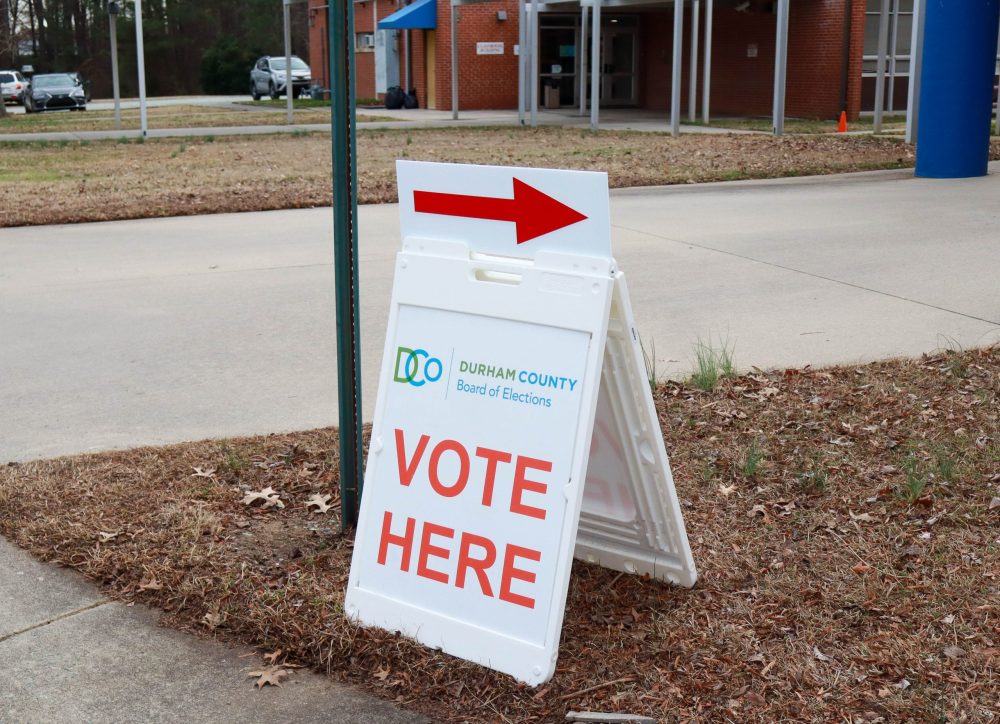
Above: A sign points voters towards a polling location during the March 3 Primary Election. Photo by Lena Nguyen — The 9th Street Journal
Sophie Endrud


