If you find yourself at Banh’s Cuisine on Ninth Street for dinner on a Wednesday, you might ask for the “Andrew Preiss Special.” Not on the menu, it’s nevertheless dished up every Wednesday. And if you turn around, you might spot the man for whom the dish is named sitting at a nearby table with his wife, Alison, his green hoodie flecked with metal shavings from a day of cutting and shaping rebar, or stained with sweat from a tense game of ultimate frisbee.
Andrew Preiss has been eating this ginger chicken and vegetable dish at Banh’s on Wednesdays since 1989. And the sculptor’s stamp shows up in many Durham restaurants: He made the grated conical lights in Vin Rouge, the warm brass trim of Nana’s tabletops, and the copper and steel bartops at the Durham Food Hall.
Like the secret menu item at the 9th street restaurant, Preiss’s influence on Durham is often stealthy. However, the metal sculptor and Durham native’s signature is everywhere – if you know where to look for it.
Freedom Riders and foundries
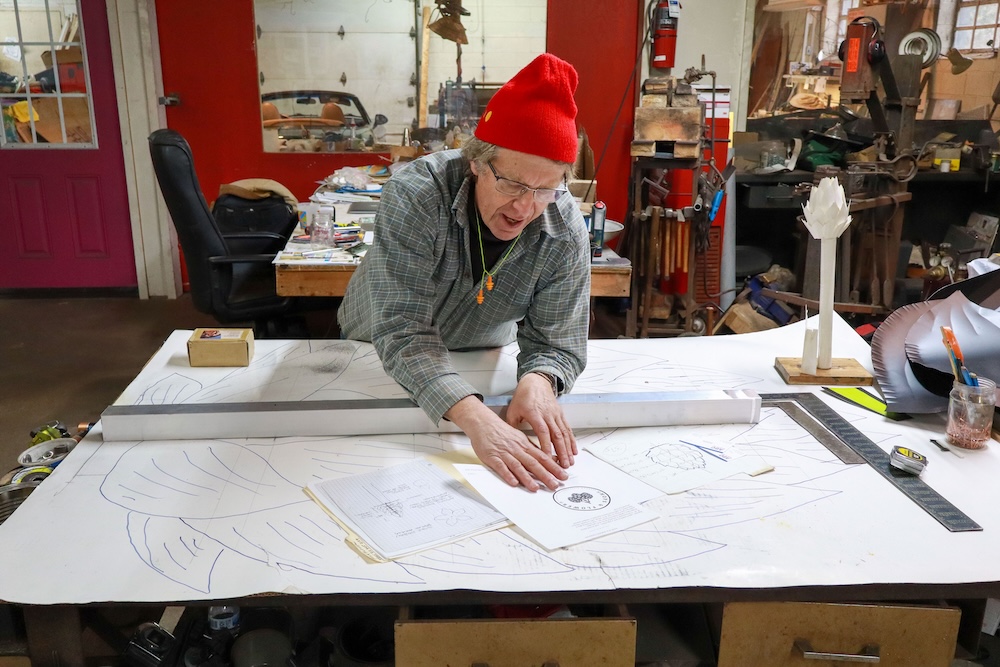
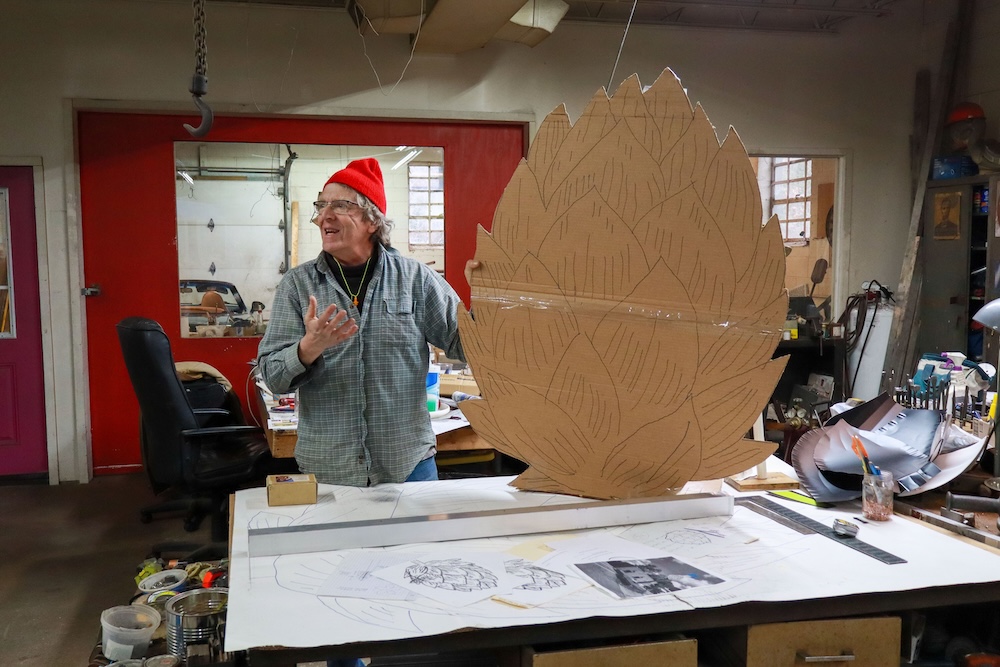
In his shop on East Trinity Avenue, scraps of brass and copper litter the workshop and heavy machines sit waiting to be cranked and pressed for Preiss’ current project. Dinner-plate-sized metal leaves litter the workbench, ready to be assembled into a five-foot metal sculpture of a hop flower for a local taproom.
Preiss’ work shows up across the Triangle. At Parizade, he created the dramatic chandeliers and host stand. In Raleigh, he made brass table tops for Bida Manda and bar tops and tables for the Transfer Company. In each case, Preiss blends steel, copper, and brass to make unconventional, flowing pieces, a style that goes back to his young adulthood.
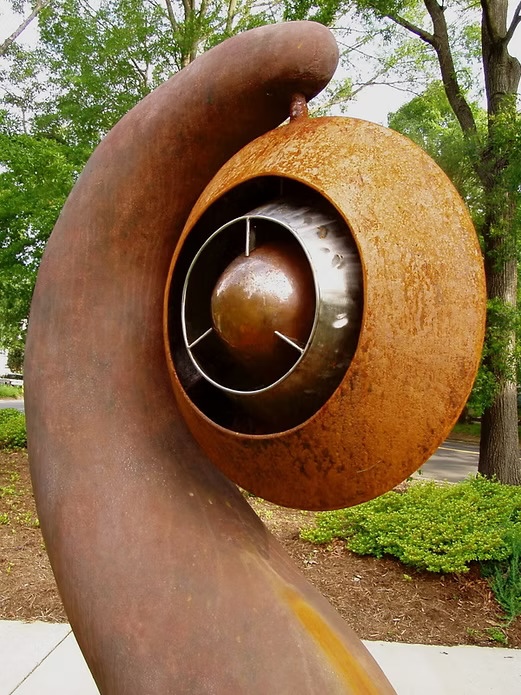
One such piece, a scaly horn made of copper, sits in front of an affordable housing project his father helped create, Andover Apartments. Preiss grew up in Durham, where his father, Duke sociology professor Jack Preiss, served on the City Council in the 1960s. Jack Preiss was an advocate for affordable housing who started the housing nonprofit New Directions for Downtown and helped establish the Preiss-Steele Place apartments for low-income seniors.
The Preiss home was a stop for fellow progressives in the 1960s. “My parents were super-connected,” Andrew Preiss said. “Freedom Riders stayed at our house when I was a kid.”
His parents also taught their children to be tinkerers and lovers of good design. The curvy fiberglass chairs and hourglass metal tables scattered around his workshop are inherited from his mom, Joan, an avid collector of mid-century modern furniture. In another corner is a children’s bicycle he worked on with his father as a boy.
“My dad fixed stuff all the time,” Preiss said. “I was around tools and car repairs… we had engines in our driveway. There was always metal.”
A frisbee pioneer
When he’s not welding brass or copper, Preiss can often be found playing ultimate frisbee.
Preiss, who helped ignite the Triangle’s competitive ultimate frisbee scene, played on the Duke ultimate frisbee team before leaving school to play the sport full-time.
“My college track was super-weird,” he said laughing. “I quit [Duke] for nine years to play.”
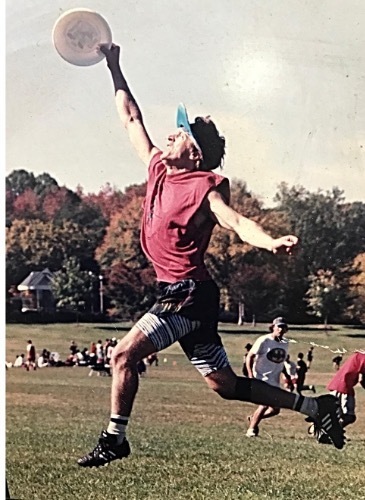
The sport was still young when Preiss became active in the 1980s. Known for his aggressive play style, he traveled from coast to coast playing ultimate.
Preiss captained a Durham team called Mr. Pouce, leading them to nationals in 1985 — the first time a Triangle team qualified. He later captained Ring of Fire, which made nationals four years in a row, the longest nationals streak to ever come from the region. His accomplishments earned him a spot in the Triangle Ultimate Frisbee Hall of Fame in 2021.
He still plays recreationally and in local tournaments, sometimes beating people half his age, says Carlton Howard, who met Preiss when the two played for different teams. “We’re both free spirits,” Howard said. “He’s very creative as an individual, and as an artist.”
After that nine-year break chasing ultimate frisbee glory, Preiss returned to Duke to major in visual art, where his mentor and set design professor, Wenhai Ma, valued reimagining traditional objects.
“[He] had an influence on the way I approach a mundane thing like a handrail or a table or a door latch,” Preiss said of Ma.
Preiss appreciates how metal can be formed into complex shapes that materials like wood can’t accommodate.
“It’s additive instead of reductive,” he explains.“It feels like building more than carving… I’ve done some sculptures where I’m removing material, and I’m not as competent.”
Some longtime customers have collected his pieces for years. Charlie Ebel, who first met Preiss in the Burch Avenue neighborhood in the 1970s, has a collection of the sculptor’s tall conical lamps.
“I’ve never seen anyone use copper so nicely. He can burnish it in all kinds of different ways,” Ebel says. “He’s not afraid to take a chance on something that might be conceived as a radical design.”
Traditional techniques in a changing town
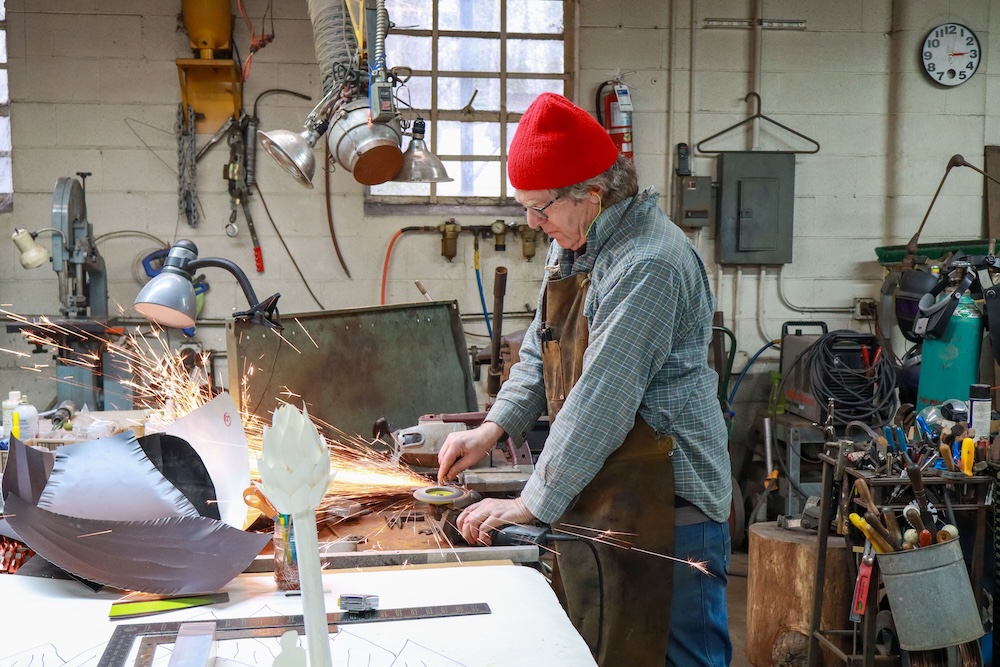
Preiss sticks to traditional techniques. He likes his sculpture models made of cardboard, and you won’t find any printers in his shop. He uses an old projector to transform small drawings into big ones and draft life-size sketches of projects.
“If I need something to be 10 feet tall, I just roll the cart back,” Preiss said. “Putting a pencil on a piece of paper is the way that I learned how to do my design work.”
He likes his cars vintage, too, driving a 2001 limited edition green Miata and a 1986 Toyota Tercel along with an old truck and minivan. The car theme recurs in a sculpture he made as a memorial for Max Rogers, a resident who helped revitalize the Trinity Park neighborhood and who drove an old Studebaker.
Yet if Preiss is old school in some ways, he is philosophical about the changes that have reshaped his hometown. “The construction of the large condos has sort of changed the way it feels downtown… it’s sort of turned into these corridors and canyons,” he says. He’s not anti-growth, though.
“I’m an advocate for urban infill and not for just endless expansion,” he said. “But yeah, parking is a pain in the ass.”
Preiss never pays to park. “I have my spots, but if I told you I’d have to kill you,” he chuckled.
Back at his shop with some leftover Bahn’s dumplings, Preiss returns to his current hop flower project. He works using old, reliable tools – such as his homemade wrench for twisting rebar — that like Durham, are lived-in, worn, and weathered.
Preiss has a taste for tradition, but he doesn’t resist the new and dynamic Durham. Instead he contributes to it, piece by piece. In return, he sometimes finds a tasty dish from one of his restaurant clients waiting on his doorstep.
When he’s finished with his new sculpture he’ll have left another mark in Durham, but not with keys to the city or something on a plaque. Instead, Durhamites experience his influence when they catch a game of ultimate frisbee or eat at one of the many restaurants where his work decorates the tabletops. Or if they stop one of his benches at the American Tobacco Campus, scattered amid the rust-colored warehouses of long ago. Or if they know enough to order a certain off-menu special on a Wednesday at the longtime 9th Street favorite, Bahn’s Cuisine — preferably served with sticky rice.
Above: Preiss at work in his Durham studio. Photo by Lena Nguyen — The 9th Street Journal
Reece MacKinney