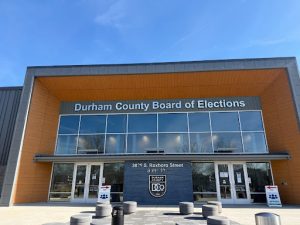
The main branch of the Durham County Library has almost everything you could want in a library: there is a video game room, an auditorium, a robust mystery section, and, for the next few days, three original copies of the Declaration of Independence.
The three documents, though copies of the original, are pieces of history in their own right, all made before 1825. Through the end of the week, they are on loan from the David M. Rubenstein Americana collection to the main library branch, and any library visitor can see these pieces of American history.
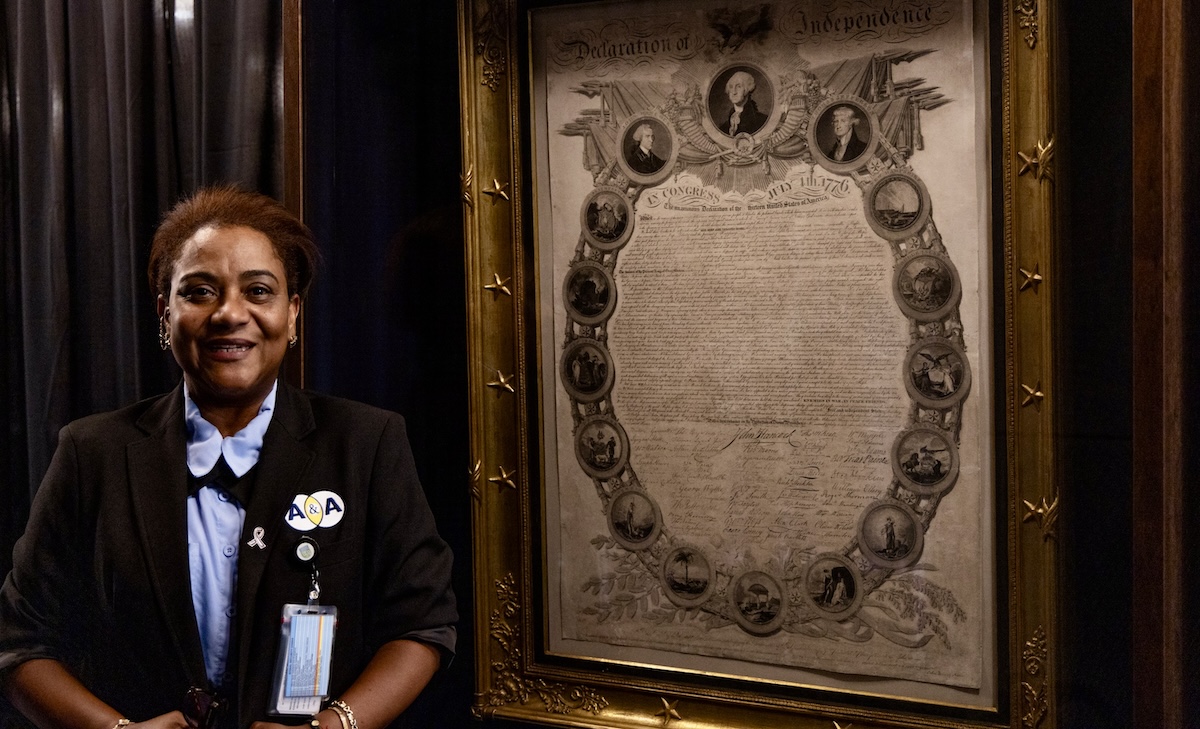
From 7 a.m. to 3 p.m. since they arrived, the documents have sat under the watchful eye of Veronica Reynolds. In her neatly pressed suit with a stack of pocket copies of the Constitution and the Declaration on the table in front of her, Reynolds might be mistaken for a tour guide rather than a security guard. This impression is compounded by the fact that, as visitors filter into the room, Reynolds presses pocket copies of the Constitution into their hands and plies them with facts about the documents on display. “Did you know these are from North Carolina?” she asks visitors, getting out of her chair in the corner to point out three signatures on the document.
Originally from the Dominican Republic, Reynolds came to the United States in 2019, and while studying for her citizenship test she learned quite a bit about early American history. “I love it,” she said. “I love learning about these things behind me.”
When the documents were first installed, Reynolds watched politicians and buses of children pass through. Now she mostly sees people in the community, coming to the library to visit a piece of their history.
“It’s very emotional,” she said. “The people need to think about this. These guys worked very hard for this Constitution, this country. And now, this moment? You never know.”
The documents on display at the library were not, as the original was, drafted to liberate a nation or establish freedom—they were created to be sold. In 1816, amidst the wave of patriotism that followed the War of 1812 and the 35th anniversary of the nation’s founding, two men, John Binns and Benjamin Owen Tyler, raced to be the first to sell prints of the Declaration and cash in on national pride.
Each man brought his own interpretation of the Declaration. The Tyler copy highlights the principles in the document, bolding words like “FREE AND INDEPENDENT STATES” and “DIVINE PROVIDENCE” in stylized fonts. The Binns copy casts its eye to the men who wrote the Declaration, slotting the text into a stylized wreath where small medallions show the Founding Fathers and images of the revolution.
The last copy is the simplest: then-Secretary of State John Quincy Adams commissioned it to be as accurate to the original as possible, with no stylized words or benevolent-looking Founding Fathers at its edges. The Stone Engraving, as it is known, is what most Americans would likely recognize, with its simple heading “IN CONGRESS” and the John Hancock signature at the bottom.
The exhibit itself doesn’t take long to peruse: a simple black cloth backdrop frames three glass cases that protect the gold-framed documents. Signage is minimal.
Still, on a recent Friday afternoon, visitors to the copies lingered. Steve and Kathy Tapp crowded together in front of the center display, pointing out details and leaning in to read the text.
“It actually gives me goosebumps,” said Kathy, turning to look back at the documents. “It reminds me of how young these people were.” She came dressed for the occasion, in a red and blue outfit with a beaded American flag bracelet.
Her husband, Steve, had visited the original in Washington just weeks before, but when he heard that the copies were on display, he knew he wanted to see them, too.
“All these diverse men were able to work together towards a common goal,” said Steve. “I think we, as a nation, have lost touch with that.”
“People should be lining up by the door to get in here,” he said.
The documents come to Durham at a time in our nation’s history that looks much different than when they were written. Then, America was fresh off a showdown with one of the world’s greatest naval powers in the War of 1812, from which she walked away mostly unscathed. Their young nation was flourishing, and people clamored to see the Declaration out of pride, a sense that the document had been the start of something great. Today, 47% of Americans believe that the nation has strayed from its founding principles.
“I feel pride, but I also feel some torment,” said Terry Banfich, standing in front of the first copy. Banfich, a retired data analyst, carries a copy of the Declaration of Independence with her most days. She has visited colonial Williamsburg, Yorktown, and Jamestown. For Banfich, the chance to see the copies was “fabulous” but also complicated.
“It’s declaring that all men are created equal, and yet we know that that was not really true,” Banfich said. “We’re not the perfect Union yet. Not everyone has the rights they need.”
Ann Tess, a PE and adapted PE teacher at a local school, agreed. Tess came on a whim, because she lives in the area and “thought it would be cool.” For Tess, the document represented “how they [the Founding Fathers] wanted our society to be.” As she walked out of the exhibit, she thought about how the document was—and wasn’t—reflected in the day-to-day. “It leaves a heavy pit in my stomach,” she said.
Next week, the copies will move to the Nasher Museum of Art, as part of an initiative called “We the People: A Duke and Durham Initiative.” The exhibit will seek to explore what our nation has been and what it aspires to be within the “complexities and contradictions of the American past.” According to the museum curators, the documents will be free of the protective glass cases, mounted on the wall as part of the rest of the exhibit. Viewers will be able to contemplate the copies of the Declaration in the context of our nation’s richness and its mistakes.
For now, though, there is no context surrounding them. The documents stand alone in the Durham County Main Library, framed only by the black draping cloth. As visitors lean in to admire the penmanship or catch a glimpse of that now-famous opening line, in the glare of the glass case they can, just for a moment, see a reflection of themselves looking back.
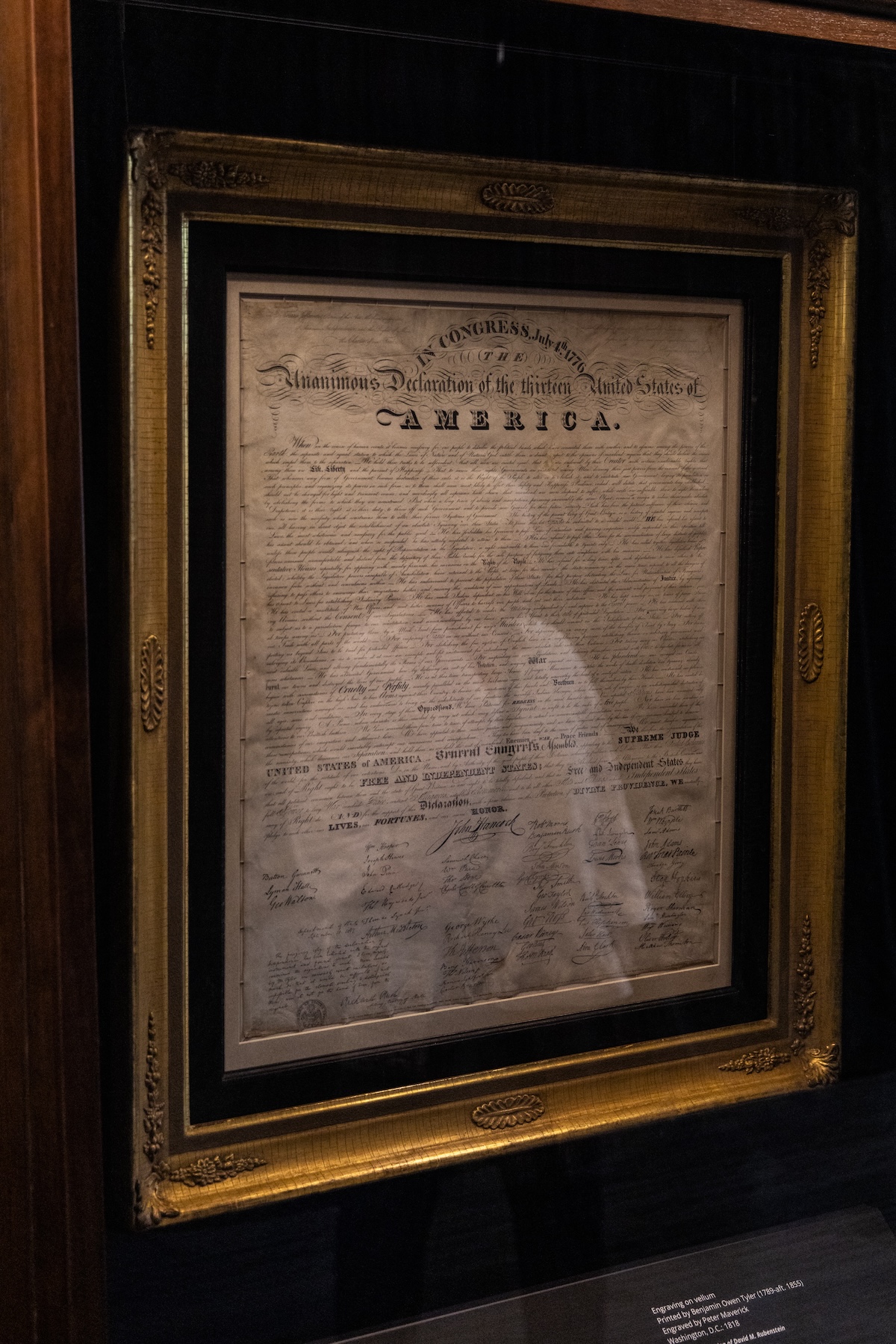
Photo at top: Veronica Williams is guard and guide at the Durham library’s exhibit of copies of the Declaration of Independence. Photo by Abby Perry – The 9th Street Journal
Annelise Bowers