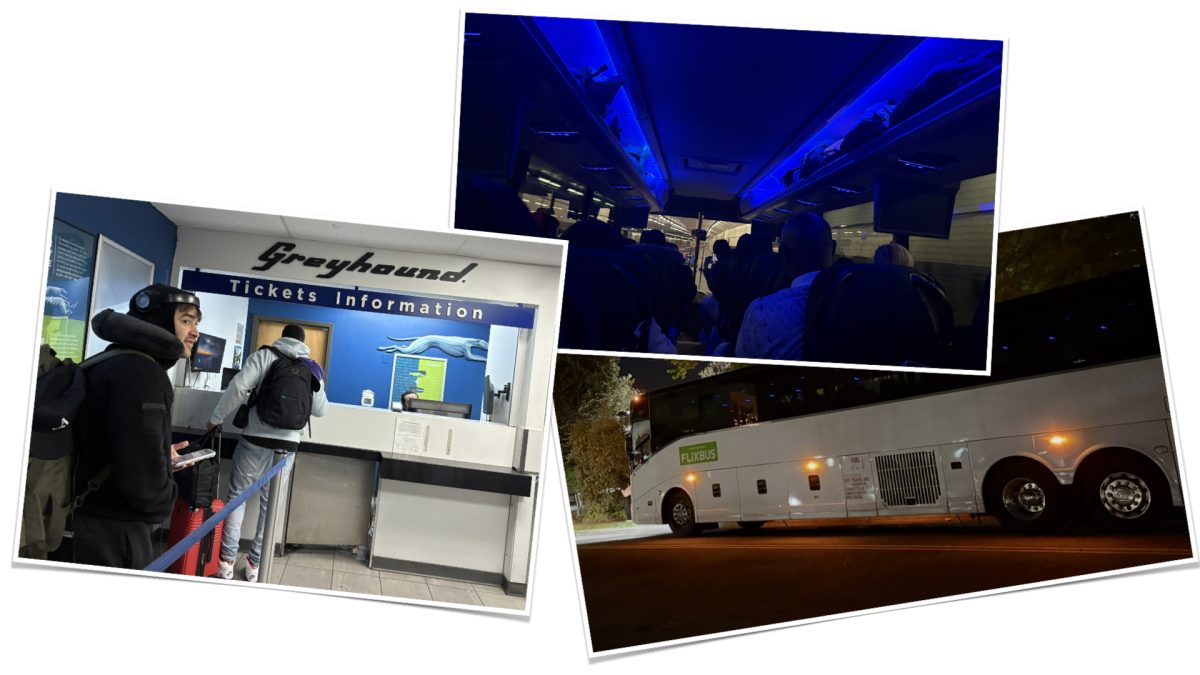
It is, among a long list of other things, a terrible time to be traveling in the United States. Gas prices are sky-high, the airports are staffed by ICE and short on competent staff, and Amtrak is rarely going where you need it to. Unless you would like to join the monks and walk, your best bet for making it to our nation’s capital might in fact be the Greyhound. As a recent “Daily Show” skit joked, “We are all bus people now.”
The advertised benefits are these: no security, no lines, no sinister armed police force watching your every move — all difficult to come by nowadays. Forget arriving four hours early to deal with TSA—you can just walk right up and get on.
To experience this aging but supposedly convenient mode of transport, I rode the bus from Durham to Washington, D.C. and back. My adventure began with a lesson about being on time: If you choose to arrive less than five minutes before your departure time, you may find yourself in the highly undignified position of running after your bus.
I set out that morning with the best of intentions: I would arrive early to chat with my fellow passengers and appreciate this workhorse of American transportation. I imagined myself, notebook out, perched on a seat at the front of the bus to ask people questions as they got on.
Instead, I woke up late (and then lay in bed for a few minutes more contemplating why I was about to spend 16 hours of my Sunday on a bus ride to nowhere), lost my keys (eventually found on the top shelf of the pantry next to the breakfast cereal), and by the time I pulled into the parking deck next to the station, had three-and-a-half minutes to make it to my bus. Even for me, this was a new low.
It is a universal law that as soon as you are running late and in a hurry, a steep hill will materialize between you and your destination. Indeed, though the Durham bus station has two lovely covered awnings with nice benches and signs right next to the parking lot, they have chosen instead to put the Greyhound bus stop up the hill and around the corner, and so I found myself struggling up the hill with my backpack and my lunch, already planning the apologies I would have to send to my editor for missing the bus.
Fortunately, in lieu of a formal check-in system, the Greyhound bus just has some dude. When I arrived at the bus stop, out of breath and flustered with only 20 seconds remaining before departure time, I found that the QR code with my ticket would not pull up. He shrugged. “Yeah, whatever. You’re good to go.” For better or for worse, I was off.
* * *
I’ll cut to the chase and say what we all already know: taking the bus is terrible. I did not need to spend 12 hours riding two of them to tell you that. Traveling by any means is full of small indignities: long lines for the bathroom, lost luggage, the woman in the seat behind you who won’t stop sticking her feet on your armrest. The Greyhound bus has all that, but with the addition of a permeating smell of cigarettes and urine, and no complimentary peanuts to soften the blow.
When I arrived at my assigned seat for Bus US0670, I found it already occupied by my seatmate’s backpack. He had his arm slung over it in a faux-casual way that clearly said “this seat is taken.” I tried to explain that it was my seat, pulling up my ticket to show him the evidence, but he ignored me and stared resolutely at the floor. Trying my luck a row back, I sat beside a woman rocking herself back and forth while she talked on the phone. As I settled in, she huffed loudly.
If, as Transportation Secretary Sean Duffy believes, “dressing with respect” is the backbone of our transportation civility, then the Greyhound bus is in dire straits. Unable to locate my jacket that morning before leaving (I was too busy looking for my keys), I instead came dressed in three sweatshirts layered on top of each other, paired with some mysteriously stained yoga pants. It was an outfit that Duffy—and my mother—would be horrified to witness, but it put me in good company on the Greyhound bus. The uniform of the day appeared to be cheetah-patterned pyjama pants and Crocs, though shoes were optional (one man, in an admirable show of commitment, remained barefoot even for his walk to the bathroom).
The bus may not have a flight attendant passing out little plastic cups of ginger ale, but it does absolve you of the need to pace the aisles or sneak in some stretches in the airplane bathroom. Instead, they kindly provide scheduled breaks for passengers to stretch their legs—free of charge! Forty-five minutes into our ride, the bus jerked to a stop and a man in Greyhound bus uniform got on. “EVERYBODY OFF,” he yelled, and I was unsure for a minute whether this was a scheduled stop or an urgent evacuation.
We all filed off the bus and into the Raleigh station to wait for our next driver. Around the room, large posters assured me that taking the bus had been an excellent choice. “MORE LEGROOM,” they advertised, “COAST TO COASTER.”
In the station, I struck up a conversation with a man who asked me to watch his bags while he went out for a smoke (I briefly considered asking him to save a few puffs for the bus, just to mask the other smells). He explained that he was travelling to Richmond to begin training for a trucking job. He would have liked to find work closer to his home in South Carolina, but no one would hire a trucker with no experience. It would all be worth it in the end, though, because he would have a job that would let him see the open countryside. I asked him if he could not do the same on the Greyhound bus, and he snorted. “If this was my only option to see both oceans, I’d just as soon not. I imagine they’re all just as salty anyways.”
As soon as everyone was comfortably settled in, it was time to line back up. We gathered bags and blankets and various vending machine purchases and shuffled towards the station exit. A man in a yellow vest announced that the process would go a lot faster if we would line up by bus, and also if we would Venmo him $20 as we came through. “I’m just kidding,” he told us, looking very much like he was not kidding. Unsure if The 9th Street Journal would cover any bribe-related expenses, I decided to take my chances and board without paying.
Back on the bus, I faced the very middle school conundrum of who should I sit with? My old seatmate had already taken her place, rocking back and forth and still on the phone with someone—not a promising companion for the next four hours. Other options were slim. Behind her was the barefoot man (no, thank you) and two rows with bags defensively piled into their seats. But then, before I could turn around and reclaim my former seat, I spotted it, the holy grail of public transportation: an empty row.
It was, unfortunately, not meant to be. Moments after I settled into my new life of luxury, a man appeared and claimed the aisle seat. He gave me a polite smile as he sat down, and given that he was in possession of both shoes, I decided to be grateful.
I introduced myself, and I learned that his name was Sabino, and that he primarily spoke Spanish. Having completed exactly one semester of (accelerated!) Spanish, I can speak confidently in the present tense—as long as I stick to the first person—and I dabble in the pretérito when I’m feeling brave. Somehow though, we muddled through a conversation, me pulling up Google Translate every few sentences or so to find a word, him giving me that particular blank smile reserved for when someone says something that makes absolutely no sense.
I learned he was from Venezuela (one word I could confidently recognize), and works as an electrician at a data center in Northern Virginia. His family is rooted in North Carolina, and so every Sunday, he makes the journey on the Greyhound from Wake Forest to Northern Virginia. “The FlixBus is much better,” he advised me. This advice, though appreciated, came a little bit too late.
In his lap, he clutched a large orange folder. I asked what was in it, and he opened it up and began to flip through. Inside were scores of official-looking documents: his birth certificate, bills to prove residency, and what I assumed were his immigration papers. “For ICE,” he explained, “Just in case.”
I opened Google Translate and looked up the Spanish word for “scared,” turning the phone towards him. He cocked his head in equivocation. Yes, he told me—but taking the bus in Venezuela was scary, too, for different reasons. He is amazed, even still, with how easy it is to get around the U.S., that we can board a bus to anywhere and not worry about whether we’ll get there.
When D.C. finally came into view, I couldn’t help it—I pressed my face up against the window to get a better view. After five hours of staring at highway rest stops and traffic, the Washington Monument was a sight for sore eyes. Sabino laughed at me. “Have you been here before?” he asked. “Yes,” I told him, “just a few months ago.” Some parts, though, will never get old.
* * *
After the 7-hour trip to Union Station and four more hours hunched over my laptop at a D.C. coffee shop fielding questioning looks about my outfit (the triple-sweatshirt combo worked on the bus. Not so much on the streets of our nation’s capital), it was time to board the bus back home. The return journey began with the thing that has come to define all modern transport: a delay.
Twenty minutes before we were set to board the bus—this time I was on the sleeker FlixBus, owned by the European company called Flix SE that bought Greyhound five years ago—I received a text notification that it had broken down. Airports are primed to handle these kinds of delays. You may not be enjoying yourself, but there is at least a seat for you and a $22 sandwich you can purchase. Union Station is, ironically, poorly equipped to handle stranded Greyhound bus passengers. Although it has amenities you would expect for a train station, few of them remain open at 9 p.m. on a Sunday. While waiting, I was chased from room to room by a security guard who patiently explained to me that yes, these seats may look open, but just because the seat is free and the room is open does not mean I can sit.
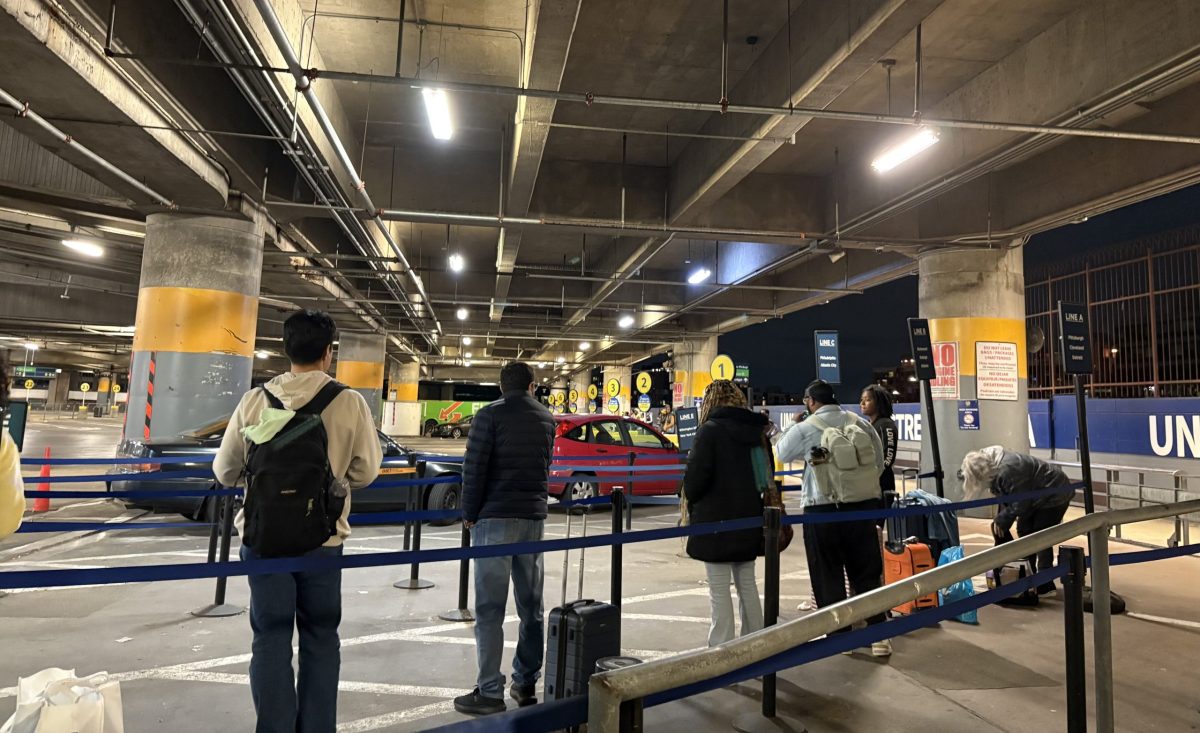
Eventually, I made my way to a chilly garage outside the station to join my fellow strandees. We huddled by the curb while a Greyhound employee explained that the bus was stuck somewhere in the Bermuda triangle that is the Northeast (New Jersey-New York-Pennsylvania?), and they would do their best to reschedule us. How many of us seriously need to be back tonight? Every hand went up.
We queued up at the ticket office and awaited our fate. One by one, passengers stepped up to the front desk to receive their sentence. I’m sorry ma’am, there’s nothing to be done, this ticket can’t be rescheduled. Please step off to the side to let the other passengers by.
The desk agent hardly looked at me when I came to the front of the line. “There’s only one ticket on the next bus left,” he announced, still typing something into the system. “We’re almost fully sold out.” This did not seem promising. “If we don’t get a ticket back, where are we supposed to stay for the night?” I asked him. I imagined a night spent on the floor of the bus station, with the security guard chasing me around saying “You can’t sleep here!” The desk agent did not respond.
He finished typing and reached for his mouse. “I’m going to submit this change. Let me know if you get an email.” I refreshed my Outlook once, and then again, holding my breath.
My inbox dinged. I was in.
* * *
The FlixBus is indeed nicer than the Greyhound. Technically, the two are owned by the same company, but the difference between the two is stark. The FlixBus looks like it was made sometime in my lifetime.
The people on the bus, however, are the same. When I arrived at my seat, my assigned seatmate eyed me with disdain. “I was hoping for my own row,” she told me reproachfully, “I really value my personal space.” I nodded and dutifully sat as far over in the seat as possible, hoping to foster some goodwill.
As soon as the bus took off, I slouched down in my seat and tried for a nap. Suddenly, I felt the firm pressure of an elbow pushing into my side. I glanced over and my seatmate’s eyes were closed in some semblance of sleep. I scooched away. She scooched closer. I moved as far over as I could, until I was sitting half on, half off the seat in a kind of quasi-squat. She tilted herself on the diagonal, head where mine should have been. Resigned, I eased myself forward and leaned my head against the seat in front of me.
Sometime around 2 a.m., the bus pulled off at a gas station for a rest stop, in a town in the middle of nowhere. Were we still in Virginia? Had we crossed into North Carolina? I wasn’t sure. The gas station was, miraculously, immaculate. In addition to moderately clean and fresh-smelling bathrooms (hallelujah), it boasted a claw machine, a hot bar, and two fully functioning massage chairs.
When I emerged from the gas station, the bus was gone. I experienced a brief moment of panic that the bus had left me behind and then saw the crowd of passengers that had gathered by the curb. Some of them looked concerned, most of them looked tired. Somewhere, one of the men had acquired a whole Little Caesars pizza.
As we waited, another man turned to me and asked, “Did you see the way our driver has been driving? He’s taking these corners fast as shit.” I admitted to him that I had been asleep for most of the ride, and anyways, being somewhat of a poor driver myself, I wasn’t really in a position to judge.
At 4:23 a.m., 19 hours after I first boarded, the bus finally jerked to a stop outside the Durham station. I gently extricated myself from the woman sleeping on my shoulder and descended triumphantly. I had made it with all my bags and most of my dignity intact, only two and a half hours or so after I was meant to arrive. Really, I thought, that wasn’t so bad! I might even do it again!
As I made my way back down towards the parking garage, I passed a man headed up the hill at a brisk clip. “Is that the bus?” he asked me, panicked. I told him that it pulled away soon after I got off. He broke out into a full sprint.
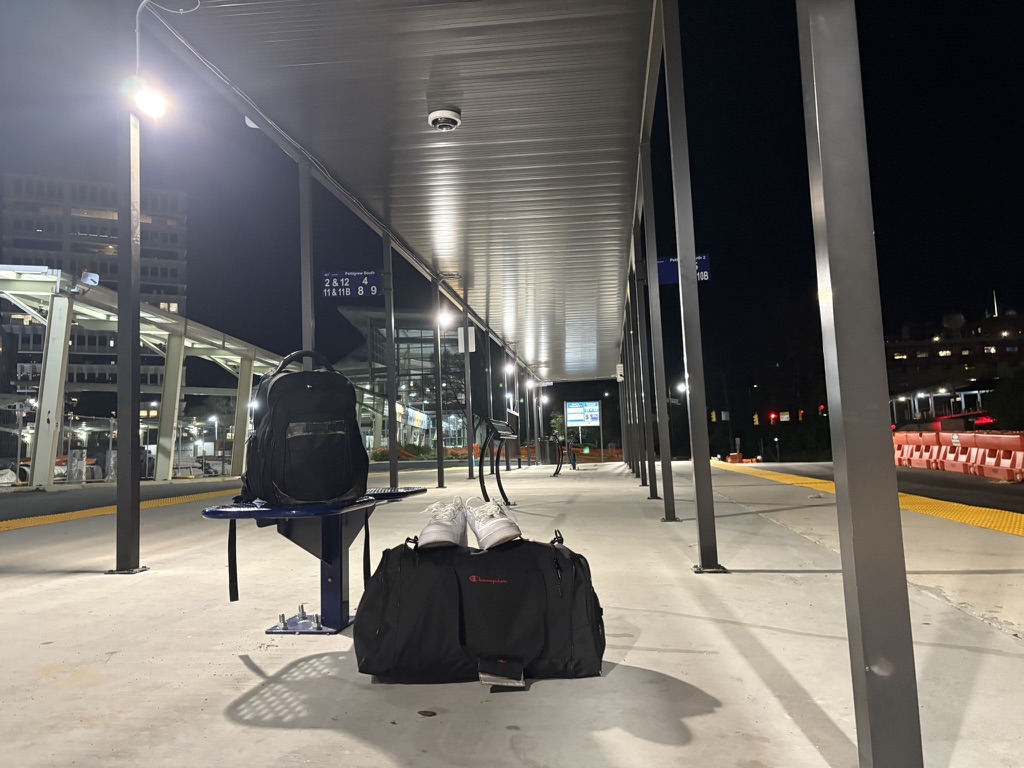
Down the hill, the bus stop was quiet. The rows of benches looked much the same as they did that morning, with one exception: a black duffle bag, a backpack, and a pair of white sneakers sat neatly on one of the benches. In the distance, I could still hear their owner in pursuit of the bus, yelling, “Stop! Stop!”
Annelise Bowers