At Walltown Park and Recreation Center, the scene has remained virtually unchanged for almost two years: large red “KEEP OUT” signs decorate the empty playground. But a much larger surrounding area, a grassy field that stretches from Club Boulevard to Guess Road, is marked only by thin orange fencing.
Walltown is one of five Durham parks where contamination from heavy metals was confirmed in summer 2023. Sections of the parks closed for testing starting that fall, and the playgrounds at all five parks closed the following spring. Late that spring, residents were told they could anticipate testing through 2025.
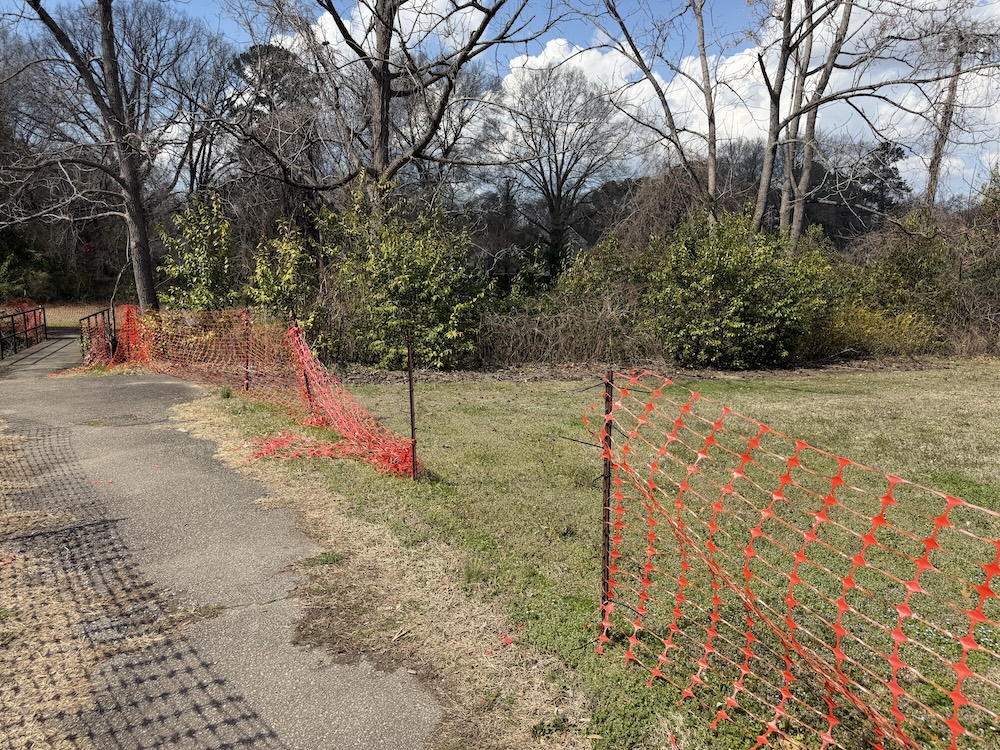
Now, almost two years since the playgrounds closed, reopening dates for the parks remain unknown, and nearby residents say they feel like a low priority for the city. Meanwhile, Walltown residents watch with concern as flimsy, unmarked orange fencing flails in the wind or falls and tangles in clumps on the ground.
Initial test results provide little comfort. A January report from the state Department of Environmental Quality shows unsafe levels of heavy metals in the groundwater and volatile organic compounds in underground gases at all five parks.
“We’re just an afterthought to Parks and Rec,” said long-term Walltown resident Valita Holmes. “There is no play area outdoors for children who are 6 to 12 years old. This shouldn’t take forever. It really shouldn’t take this long.”
Mary Unterreiner, public information and communications manager for the city parks and recreation department, says that the five parks have been her department’s highest priorities since the day the reports came out.
“We don’t take it lightly when we have to remove amenities from our system. We are all in this industry because we care about parks and recreation and we care about what it does for the community, and so it’s an extremely high priority when we have to close parks because of a safety issue,” Unterreiner said.
The January state report detailed test results from monitoring wells and gas probes in the affected parks. After a year of testing, the department still noted unsafe levels of heavy metal in groundwater samples in all five parks. They also installed probes to test the gases within the soil, finding volatile organic compounds in those screenings in the parks.
Meanwhile, residents feel these contaminated areas are not properly cordoned off. Holmes has repeatedly informed the city about fencing drooping to the ground near Walltown Park Recreation Center, she said, as long ago as last summer and as recently as last month. The building sits on the boundary of the contaminated field.
Unterreiner said her department is aware of downed fencing at Walltown Park, and has sent staff out to secure or replace the fencing. The department responded to another incident of fallen fencing in Walltown Park in February, she said.
“The community in Walltown has been great about alerting us of specific issues, and we’ve been out there recently because we had some feedback from residents within the past few weeks that [fencing] needed to be restabilized and some signs needed to be replaced,” Unterreiner said.
Holmes’ greater worry, though, is inadequate signage around some contaminated areas at Walltown Park. A black chain link fence surrounding the playground has red-and-white signs that warn about contamination and ongoing testing. But right next to the playground sits a grassy field that is also a contamination site. The field, which wraps around basketball courts and a section of Ellerbe Creek, is largely surrounded by orange plastic fencing, but no signage explains why this area is off limits.
“It’s a hazard and people should be made aware, and [the city] should have done that right away,” Holmes said.
Holmes said she has seen kids stepping over the plastic fencing near the recreation center to take a shortcut through the grass to the basketball court.
“The fencing was down, and they just walked across and were playing on the basketball court, but all of that area is supposed to be off limits,” Holmes said. “My concern is that there’s no wording so people don’t know why that fencing is up.”
Unterreiner said staff regularly check these areas and complete additional checks when Walltown residents share concerns about maintenance.
“[Walltown] keeps us pretty well informed when there are issues we need to address and we do our best to address them right away. There should be signage out there, and if there’s not at the moment, we will go make sure that there is some,” Unterreiner said.
Council member Matt Kopac has heard similar concerns about poorly maintained fencing at Walltown Park from other residents, which he says he relayed to the parks department. He is also concerned about downed fencing at Northgate Park.
“I’ve heard that concern expressed in the past, and I’ve seen it at Northgate Park as well where my kids used to hang out,” Kopac said.
The Walltown Community Association sent a series of requests to the recreation department in December, including a request for an increased budget for the park cleanup project. In a response letter to the community association, parks director Wade Walcutt said that the department does not plan to request additional funding for remediation this fiscal year.
Holmes, Walltown resident Danielle Doughman, and other Durham residents met Feb. 12 over Zoom to share updates and connect in their shared frustrations. The funding decision was a central focus of the meeting.
“We were very disappointed to learn that there was no budget request made,” Doughman said at the meeting.
The city allocated $12 million over the past two fiscal years to the remediation of these parks. That money has not been spent, Unterreiner confirmed.
Unterreiner said the department is awaiting further information about soil testing results and cleanup options before requesting additional funding. The N.C. Department of Environmental Quality is expected to present a summary of final test results and recommendations to the city by the end of this month.
“The rationale is that we wouldn’t be able to spend more than $12 million in a year on whatever the remediation needs are,” Untereiner said. “We have the money we need to get us started. We just don’t really know what the best course of action is going to be until we have better cost estimates on what it’s going to take to remediate the parks.”
Kopac said there is still hope for park remediation funding in the near future. He said exact funding needs will remain unclear, though, until the city receives the Department of Environmental Quality’s report.
“The current budget is not closed until we pass it in June, so there’s an opportunity to advocate in this budget cycle,” Kopac said. “But it’s also unlikely that the $12 million will be spent in the next fiscal year, so the next cycle would be enough time to request additional resources for remediation.”
At the Feb. 12 meeting, Durham resident Ashley Scott expressed frustration with the city.
“There’s this continual sort of ‘pass the buck along.’ I think their belief is that it’s important, but it’s not as priority as other things,” Scott said.
Kopac says that the issue is an important one for the community, but the city is still awaiting a final report from the state before they can discern the needs of each of the five parks.
Holmes also worries about the impact of the contamination in her neighborhood for long-term Walltown residents like herself. During her childhood, near the current location of the park’s recreation center, kids in Walltown frequented a playset complete with a metal slide, a swing set, a merry-go-round, and played ball down the hill at a basketball court.
The playground equipment is now gone, but the basketball court remains at the bottom of a hill outlined with orange fencing.
“We all played down there, and it had a little sloping hill. We got up on the top of the hill and we rolled down on that, and we had no idea,” Holmes said.
Holmes, Scott, and Rosenthal worry that the city plans to pass the task of remediation on to future generations.
“This kind of legacy of environmental racism has got to be called out… this was going on for a long time….” Rosenthal said at the meeting. “That’s just my bottom line.”
Unterreiner said the department is working hard and diligently towards resolving the issue. She acknowledges, though, that any amount of time without a park open is too long for children in these communities.
“We inherited this issue, so we’re doing what we can to make it right for the community and make sure that that legacy of environmental racism doesn’t continue under us,” Unterreiner said.
At top: The Walltown Park playground has been closed for nearly two years while testing for contamination continues. Photo by Halle Vazquez — The 9th Street Journal
Halle Vazquez