

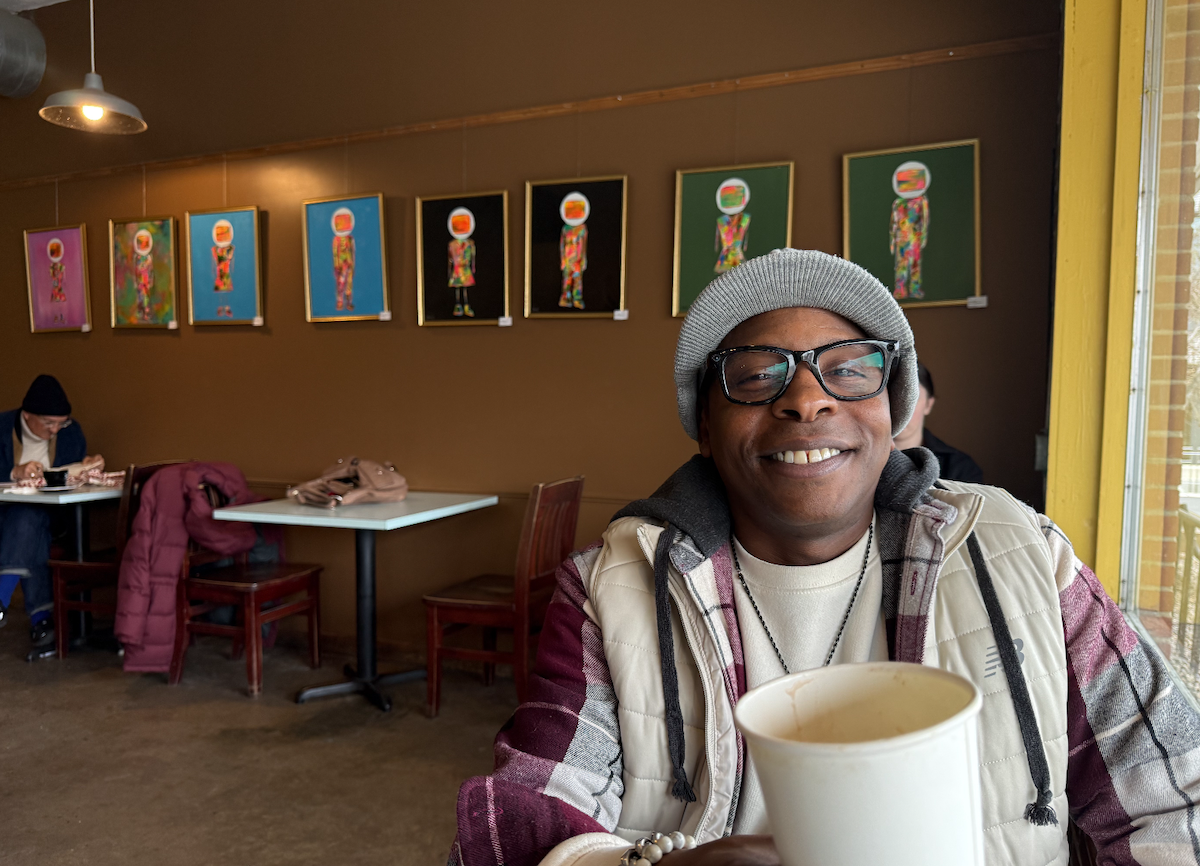
In the great tradition of government buildings, the main office of the Orange County Local Reentry Council is “barren of existence and bad for the psyche,” according to the group’s coordinator, Benjamin Gear. So, on nice days, Gear packs up his belongings and decamps to the friendlier grounds of the Open Eye Cafe, a Carrboro coffee shop.
He has staked out one of the weathered picnic tables in the front as his own. As he settles in, propping his backpack on the bench beside him, Gear tosses out greetings to people who pass by—a wave for a neighbor; a broad smile for someone he met once through work; a quick conversation with the barista. The outside tables are best, he explains, because they allow him to stay far away from everyone. “Actually,” he tells me with a little smile, “I hate people.”
This is difficult, because as the program coordinator at the Council, Gear’s job is people. He had no qualifications when he was hired, he said, except for a powerful story and a gift for telling it. “The job was certainly above anything that I had ever done, but I felt like, given my story, I had to take it.” A Chapel Hill native, Gear dropped out of high school shortly before graduation and began spending a lot of his time in bars, receiving five DUIs and fathering several estranged children until he decided to get sober. “Coming through all of that stuff and making it to the other side,” he said, “I had to give back.”
Having deigned to tolerate me, at least for a few hours, the supposedly people-hating Gear invites me to the Open Eye Cafe to watch him as he works. The day is warm, but he’s dressed in much the same way that he was when we met on Zoom a few days prior: fashionable black glasses, a sweatshirt with the hoodie up, and a bright yellow beanie pulled down to his eyebrows. The outfit is offset by a wide, easy smile, and when he talks, Gear, 45, interrupts himself sometimes to throw his head back and laugh.
It’s do-good Friday, a Ben Gear tradition, so before he can sit down and begin working, he heads to the counter to hand out a box of doughnuts to the coffee-shop staff. Gear, the self-proclaimed people-hater, watches from a few steps back with a smile as the people in line behind him, inspired, begin offering to pay for each other’s drinks. “People deserve something good,” he said by way of explanation, turning back from the scene. “They deserve some real kindness.”
Unfortunately, Gear doesn’t think his job quite fulfills that goal. A LinkedIn description hints at his career frustrations: He lists his occupation as “Writer by passion, servant of the people by appointment.” Rather than guide people finding their footing after incarceration, Gear feels like he is the spokesperson of an inflexible organization led by people that he believes are committed more to improving appearances than helping with reentry.
At the cafe, he has brought an impressive spread of equipment: two laptops, two phones, and an enormous water bottle to hydrate him through long hours at the computer. But right now? There isn’t much work to be done. Gear is trying to rebuild his executive committee, the foundation of the LRC’s operations. “It is the most important component of the LRC, right? It is to be comprised of, quote, important people in the community that can help impact change. But for so long, they’ve just been meeting every quarter and listening to presentations without any discussion!” Gear rolls his eyes, frustration breaking through. “Some people on the committee didn’t even show up to the meeting. I’m trying to change that. ”
He’s emailed 29 possible candidates so far —lawyers and mayors and police, people in service to the community. Only eight have said yes. He fiddles with his laptop for a minute before flipping it shut. “I want so badly for this to help things,” he said, “But given the history of this committee, the history of this place? I’m nervous.”
***
The final time that Gear was arrested, he was asleep. After dropping a friend off somewhere, he got stuck at the stoplight of a deserted intersection on his way home. It was late at night, and there was no one else on the road, so Gear closed his eyes for a moment. When he awoke, he was in the back of the cop car in handcuffs, the officer ready with a breathalyzer. . He blew a .27, three-times the legal limit.
That night in April 2014 was a cap to a long struggle with substance abuse. Gear started drinking in high school, searching for a distraction from his parents’ separation and his sexual abuse by a teacher. He tells this story with a levity that belies its deep tragedy, and speaks to how far he has come since those days. Laughing at himself a little, he remembers, “I found the bar and was like, ‘Holy cow, this is amazing!’ And then I did that for the next 17 years. Just partying, ridiculous behaviors and DUIs.”
Nathan Mills met Gear before the drinking began. A high schooler living on his own, Mills was searching for a roommate to share the cost of rent and happened upon Gear, who had recently dropped out. “The Ben that I met when I was a kid—it really felt like a dose of authenticity. He had this very optimistic, beautiful vision of the world.” But Gear was struggling with the things he had experienced, and when turned 21 and found the bars, “I just began to run away.”
For him, the appeal of alcohol was not just in oblivion, but in the social benefits—it helped him find a kind of community. “On the bright side,” Gear said, “I frickin killed it. I was exceptionally known, and everybody thought I was the coolest person.” At the bar, Gear found a place where he was liked, and a version of himself that felt easy. The drinking came with consequences, though: At 35, this DWI would be his fifth.
In the state of North Carolina, the fourth DWI is where things really get serious. At your first, you face fines, insurance consequences, and a license suspension. At the second, you may have to give up your vehicle or install an ignition interlock device. At the third, the state is allowed to prosecute your case as a felony, and at the fourth jail time is usually a sure thing. On the NCLawTalk website, after a long list of consequences (PERMANENT LICENSE REVOCATION; FORFEITURE OF PROPERTY, IMPLICATIONS ON EMPLOYMENT AND HOUSING), they try to offset the severity of these penalties pronouncement with a small aside titled “A Ray of Hope” – as in, there is very little.
His lawyer certainly agreed. “I called my lawyer after and he told me, ‘Hey bro, you’re going to prison.’ In the courtroom, things seemed even more dire. The district attorney called him a “danger to society”, and petitioned for a bond modification to hold him in jail. The judge, however, disagreed: Gear had no other criminal charges, so the judge decided he was “rehabilitatable” and sentenced him to a rehab program.
As anyone might when they’ve just received their fifth DWI and are bound for rehab, Gear kicked off his attempt at sobriety with a “massive kegger.” There were drinks and a cake and a book to collect addresses for Gear to write letters to. “Rehab” by Amy Winehouse was played on a loop.
When the party was over, Gear packed himself up and headed to Black Mountain to begin treatment. During the day, he worked in jobs that the rehab center had found for him. He was a trash man on the back of the truck (“I don’t know if you can get this from my demeanor, but trash is just not my thing, you know? And on the hills there, the trash is always falling back on you.”), and also worked at the Civic Center in downtown Asheville. “I really, really, really, really wanted to be different,” he said. At night he read the Bhagavad Gita, a Hindu scripture, and he wrote letters to all of those addresses in the book. “I knew that I needed to own some real things in my life.”
A few months into working at the Asheville Civic Center job, Gear discovered something deep in the basement: a beer tap. That there would be alcohol on tap at a job assigned by a substance abuse rehab center is a stroke of deep irony, and that it would be deep in the basement where no one can see you have a drink is an even greater one. “Every day I would have a beer, one beer,” he explains, “and then one day after a month I started to have more than one.”
When he returned to Chapel Hill, he slid right back into his circle of friends at the bar, figuring that staying clear of hard liquor was close enough to sobriety. “I had a commitment to not drink liquor, and I would go out, but it just seemed like everybody was having more fun than me,” he said with a little laugh. And so, one afternoon, he asked a friend to play bar golf, to take shots from every bar downtown.
By the end he was—as anyone would be after upwards of ten shots of liquor—quite intoxicated, so a friend helped him get home. They sat on the porch of a coffee shop together as Gear cried. “That was my come-to-Jesus moment where I was just like, I don’t want to be this person, you know, like, but what am I supposed to do?” It was December 10, 2015. He has not had a drink since.
***
Gear has two nearly indistinguishable phones: one for his personal use, and another reserved purely for work that he calls the “batphone.” The batphone holds the phone numbers of the most
important judges, mayors and police chiefs of Orange County. Given his general grumpiness about the county’s lack of commitment to his program, none of them would be happy to hear from him.
The official goal of the Local Reentry Council is to reduce barriers to reentry for formerly incarcerated people. The group provides assistance with case management and immediate needs such as housing, transportation, and employment, as well as loftier needs — goal-setting and connection to community support. They have an executive committee, a body of advisors, two subcommittees, and a string of local referral partners that provide services that people coming out of prison need.
When he was first hired, Gear was invigorated by all of the possibilities of his new position. He had been waiting, he said, for a chance to help people, to make meaning of his story and give others the light he needed. “I think there’s nobody better to help people figure out how to get their life back in order than Ben,” said Nathan Mills, a childhood friend, “Because he had to traverse such a long distance, he’s unlikely to run into many people who have a further distance to travel from the consequences of decisions to a beautiful life.”
Gear said he threw himself into his new position with a single-mindedness, drafting plans for new programs and suggestions for simple things the county could do to help people. “Ben is incredibly intelligent. And so he’s very strong minded,” Mills said,“When he has sort of an idea or a vision, you know, you’re not talking him out of it.”
He began asking difficult questions in meetings; he pushed for an answer on why the council was doing so little to expand its offerings and actually help people. “Finally I just get fed up because I’m like, why is no one doing anything? So I’m sending emails to the county commissioners, all three mayors. You know, I’m asking direct questions like, hey, why doesn’t anyone care? Why is no one responding?”
He never got a response to those emails—he said what he got instead was a meeting with his boss, who told him that he was making people unhappy. He should not continue to ask the uncomfortable questions or send out any emails. For weeks after that, Gear was inconsolable. He submitted his budgets on time, but got little else done. No one checked in on him.
He watched Chapel Hill, the town he’d grown up in, cede ground to developers and the slow creep of gentrification, and he began to see the council’s work as enabling this. Though a buffet of programs exists to “help” people on their way to reentry, none of them, Gear said, are actually giving people what they need. “We help people find jobs, but it’s not sustainable,” he said, “You can’t work at Wendy’s full time and pay for rent. It just doesn’t work.”
“It’s heartbreaking work. It’s frustrating.” said Tiffany Bullard, Gear’s colleague at the Reentry Council. She works on the client-facing side, meeting directly with people being released from prison to connect them to resources. She shares some of Gear’s feelings. In the six years since Bullard was hired, she’s watched changing leadership and a lack of direction from the Department of Adult Correction make finding the way forward difficult.
But Bullard has also seen the incredible good that the Reentry Council can do. She has found housing for people who would otherwise be out on the streets; she has placed people who thought they might be unemployable into jobs; she has helped people piece their lives back together.
“I’ve been there. I’ve been Ben,” she said, “There are all of these messed up things right in front of your face, and you think, ‘This has to change now, this isn’t right.’” But she has learned that progress comes slow. “Ben has a good heart and wants to see systematic changes happening super quick. But in life and movements and systemic change, it takes time.”
Gear’s boss, Danielle Carman, director of the Criminal Justice Resource Department, disagrees with many of his complaints. She believes that the Reentry Council makes a significant difference in the lives of people facing reentry. “It is difficult to overstate the impact that a friendly, supportive face can have for folks,” she said. But even in Orange County, one of the richer counties in the state, the resources available to the Reentry Council are “grossly insufficient to meet clients’ basic needs, let alone to help them prepare for true self-sufficiency in a modern world.” The Reentry Councils’ two-person team does tremendous work, but Carman said they need the support of local businesses and community leaders to make a true difference.
***
Benjamin Gear is not a man afraid of difficult truths. He shares details of his addiction and recovery with the same nonchalance he uses to wave down someone at the coffee shop; He speaks of the failures of his job with a frankness that is less bitter than it is honest. He’s come to accept the limitations of his position, and his own limitations.
Since recovering from addiction, Gear has spent a lot of time in deep reflection. In the early days of his sobriety, floundering for a direction and “learning how to be a regular human again,” he started a blog called Perfectly Imperfect, where he confronted difficult truths about himself and his addiction. He wrote about reuniting with his daughter, about feeling like other people’s token Black friend, about hitting plateaus in his recovery. His blog took off — before long, he was selling merch, and getting recognized by people for a platform where he shared some of his most difficult experiences.
“I felt a responsibility because I lived my life so publicly, you know, I was always that dude,” he said, “These are things I needed to own outwardly.”
He emphasizes: The writing came before the drinking. In high school, he would sneak into the computer lab and write—not deep reflections or a novel, but erotic short stories and romantic poems. Then, he would auction them off to the romantically illiterate boyfriends of the school, acting as a modern day Cyrano de Bergerac for the not-so-modest commission of $5 and earning a little distance from his reputation as the school’s innocent church boy.
As an adult, Gear has returned to writing as a way to make his voice heard—even when in a system that doesn’t want to hear it. Having shuttered the blog when he began at the Reentry Council, frustrations with his job encouraged him to revive a passion for rap, funneling his anger into songs that he posts on SoundCloud. Gear is not ashamed to admit: “I’m a horrible rapper.” But writing the songs has helped him make sense of it all—the failures of the justice system, the gentrification of his community, the systems that keep it all running. Here’s a passage from his album “Sunday Sessions Vol. 5.”
Searching until they find the perfect spot to purchase ignorance who occupies it
Raise the price to determine who deserves to be inside it
The soul of the town I once loved has been accosted.
When Gear was younger, he and Mills would spend hours having big conversations about the good they wanted to do. “We believed that we could affect change in the world. We would sit around playing video games and talk about life, about what is good for the world and the way that we could use our gifts to make it beautiful.” Gear’s vision of the world now is tinted with a shade of cynicism, brought on by all that he’s been through and how hard it’s been for him to bring that vision to life. But the longer he talks about his job, the more his original optimism shines through.
“I’ve been frustrated with people choosing to not care about people who need to be cared about.” he explains, “But I’ve learned that you can’t teach care, you can’t force people into it. I just have to keep helping out in the way I can, doing what I can do.”
***
Sometimes, Gear’s work takes him back to the start of this journey: a courtroom. Though much about him has changed since he first sat in one awaiting his ruling, little else has. Today, he sits in on a case with the judge who chose not to send him to jail; the lawyer who argued that he was a dangerous criminal stands in line with him for the water fountain. Gear takes a breath before he sees these people, and then faces them with a smile. He walks into the courtroom, and then walks out again, just to prove he can.
Update: After this story was published, Gear provided clarifications and additional details about events before he gave up alcohol. This story has been updated to clarify and correct those details, as well as the full name of the council.
Photo at top: Benjamin Gear at work in the Open Eye Cafe, his favorite coffee shop. Photo by Annelise Bowers – The 9th Street Journal
Annelise Bowers


