Maps and detailed survey results stretched across tables on a recent Wednesday as residents moved from station to station, scribbling feedback on Post-It notes. At one table, longtime North Durham resident Jennifer Edwards studied the plans for the proposed Durham-Roxboro Rail Trail. She praised the rest areas, the trail’s length, and the ability to ride her bike without the interference of cars.
“I think it can bring a sense of community,” she said. “We are taxpayers here, and this is our community… using [the land] for a purpose such as this…is great.”
Other residents, however, are less enthusiastic.
Kathy Bowman, whose property in Bahama borders the proposed trail, called the project “a grandiose idea that it’s just not practical.”

The proposed plan seeks to transform an 18-mile inactive rail corridor into a multi-use trail. The trail would ultimately include an additional eight miles and would stretch from downtown Durham to Roxboro. The project is spearheaded by Durham County, Triangle West Transportation Planning Organization, City of Durham Parks and Recreation, North Carolina Department of Transportation, and East Coast Greenway Alliance.
The corridor, owned by Norfolk Southern, has been abandoned since the early 1980s and was identified by the Durham community early on as a promising route for a multi-use trail. Only recently, when the company expressed interest in selling, were the City of Durham and Durham County able to initiate the acquisition, with the help of a $500,000 grant from the North Carolina Department of Natural and Cultural Resources.
“It should close… in the next couple of months,” said Caroline Stahlschmidt, senior project manager with Destination by Design, the consulting group that led the workshop.
After launching preliminary research and analysis in the fall of 2024, planners from both Destination by Design and Toole Design are now drafting recommendations for the trail concept plan. Their work draws on feedback from the first round of community meetings in February and a survey in which 80% of 2,994 participants expressed support.
Through workshops and surveys, Durham County and its partners have emphasized the importance of public engagement.
“It’s not being built at this moment,” said Evan Holiday, landscape designer with Destination by Design. “We just want to know what kinds of things [locals] would like to recommend.”
Preliminary ideas for the project include providing trails, rest areas, historical sites, and easy access to commercial and shopping areas.
Justin Farmer, a 33-year-old cyclist and trail user who lives near Duke Forest, has followed the project since the baseline survey and likes the idea of a trail stretching north to Roxboro.
“I think it’s cool to be in on the ground floor of something like this, and have the opportunity to shape something in my community,” he said. “I’m really excited…. Seeing the city by bike…I think it makes me slow down and, notice my neighbors in different neighborhoods.”
Old West Durham resident David Bradway, who co-chairs the Bike Durham Advocacy Committee, applauds the trail’s potential as a connector.
“There are some preserves and wetlands and lakes and mountains to see that cross this Durham to Roxboro trail,” he said. “I think it’d be a really nice opportunity for people to explore this part of the county and to make connections to libraries, schools, and other facilities that are a little hard to get to except by car.”
Other residents are more skeptical. Each workshop has drawn between 40 and 70 participants, and planners say that as meetings have moved farther north along the proposed corridor, the feedback has grown more heated.
Kathy Bowman is among those who question the plan.
“Those of us who have property out here in a rural area selected a rural area to live in, and I can’t think of anybody except one person that I have talked to, who lives in this area, that is interested in seeing it to completion.”
Another woman who owns 20 acres near the corridor agrees. “It’s a nice idea, just not in my backyard. I know my immediate neighbors feel the same way.”
Both raised concerns about safety and infrastructure. Bowman questions whether the area could support trail users. “There’s not going to be support in the form of, say, an ambulance, if you needed law enforcement or if any crimes are committed,” Bowman said.
Aware of these concerns, project leaders have held difficult conversations with residents along the corridor.
“We can’t please everybody,” said Holiday. “But [the goal] is really trying to integrate as much feedback as we’ve heard.”
Planners are considering how to create space for equestrians and how to manage vegetation levels and interpretive elements, she said. To address privacy concerns, designers are considering the use of fencing or privacy barriers to distinguish trail space from private property.
Safety has also been a focus. The team is coordinating with the county sheriff’s office and applying environmental design principles, such as including additional lighting, to prevent crime.
The trail planning and design development is backed by a recent $400,000 grant from the Triangle West Transportation Planning Organization and $100,000 from federal allocations. Opportunities for public input continue via an online survey. Construction is expected to be completed in segments, as funding remains dependent on future federal dollars.
As the recent trial information session wrapped up, Edwards added her own Post-It to the map. On it, she asked for the addition of non-functional phones along the path, where people can talk through grief, tragedy, or loss in the comfort of the outdoors.
Edwards has been advocating for this idea since the initial survey, though she remains uncertain about how well it has been received.
Planners, meanwhile, have other questions to tackle. For now, if the trail is to fulfill its vision of connecting Durham to Roxboro, planners must first find a way to bridge the different mindsets and desires of local residents.
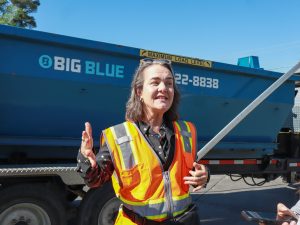
At top: Holly Waterman with Destination by Design answers questions about the proposed Durham-Roxboro Rail Trail at a recent information session. Photo by Ava Epstein — The 9th Street Journal
Ava Epstein