Tuition fees may soon increase for before school, after school, summer, and intersession programs at Durham Public Schools. Without an increase, the district expects to run a $2.26 million revenue deficit in the programs by the end of the 2025-2026 school year, administrators said Thursday.
“A tuition increase is necessary to maintain program quality, meet licensing requirements, retain qualified staff, and ensure long-term financial stability…of the program,” said Tracey Super, director of community education, at a school board meeting Thursday.
Total expenditures for what are known collectively as community education programs could reach up to $6.2 million this year, while total expected revenue falls short at $3.9 million.
Following tense debate, the school board moved to postpone a final decision on tuition increases to the Feb. 26 board meeting.
For the last five years, the state’s Child Care Stabilization Grants — stopgap measures funding state-wide childcare programs — propped up the school system’s community education programs.
Those grants, funded by the American Rescue Plan Act of 2021 in response to the pandemic, ended in 2025. At Thursday’s meeting, district administrators proposed 35% or 50% registration and tuition fee increases for all community education programs.
“There’s no other revenue that supports the program,” said Dietrich Danner, the district’s executive director of federal programs and community engagement.
Monthly after-school tuition currently stands at $205 for elementary students and $100 for middle school students. Tuition fees for all community education programs have not changed since 2016.
A 35% increase would bring after-school tuition fees to $276.75 per month for elementary students and $135 for middle school students, while a 50% increase would bring those numbers up to $307.50 and $150 per month, respectively.
The 35% tuition increase would still leave the district more than $242,500 in the red. A 50% tuition increase would leave an excess of $313,570.
Several school board members were reluctant to make a final decision in favor of either increase at the meeting. Some, including board member Millicent Rogers, were visibly upset with the limited time available to make a decision.
“I don’t like that the board is backed into a corner, in the same way that we were on financial issues…,” Rogers said, wringing her hands. “I would strongly encourage my colleagues, Dr. Lewis, your staff, to get it together.”
Board members Joy Harrell Goff and Bettina Umstead emphasized the need to solicit feedback from community members who would be affected by the tuition increases.
“To do this without community feedback feels like we would be making the decision on the backs of working families,” said Harrell Goff. “And so, I would appreciate having some space to be able to hear from families.”
As an alternative to sweeping tuition increases, board member Jessica Carda-Auten raised the possibility of a “sliding scale,” in which tuition increases would be tiered according to family income. A sliding fee scale is used by Durham Parks and Recreation for many of its programs, she said.
“There are people who would be willing and happy to pay more because of the service that they’re getting…,” board member Emily Chavez agreed. “What’s proposed [by administrators] is more of an equality model, but with equity, some people could pay more, other people could pay less.”
Yet a sliding scale could be difficult to devise and implement in practice, said Deputy Superintendent Nicholas King. King said a sliding scale system would necessarily introduce income quotas, since the program would depend on higher-income families paying higher fees to balance the lower fees paid by lower-income families.
Additionally, administrators do not know how many families will take part, nor their individual household incomes — data that are critical to creating the sliding scale models. “I wouldn’t feel comfortable doing this [sliding scale modelling] without that information,” said Rubhean Barfield, senior executive director of financial services.
Despite concerns about the paucity of data and limited time frame, Super and Danner agreed to devise sliding scale tuition models for further review.
The lottery for summer camp programs was originally set to begin in February, while the lottery for afterschool programs was to begin in March. These deadlines were postponed at the meeting to give administrators time to formulate new sliding scale options.
Tensions sparked briefly as school board members debated what tuition increases were tolerable. Chavez advocated for a 50% tuition increase, but with a sliding scale to accommodate different income levels.
Board member Natalie Beyer vehemently disagreed. “I very much think that the bottom line on [the 35% tuition increase option] might be the better place to model towards…,” she said. Then, looking across the board at Chavez: “And you, personally, are comfortable with the 50% jump for families?”
“What do you mean, I’m ‘personally comfortable’?” Chavez shot back.
The school board ultimately asked administrators to provide sliding scale models with varying levels of tuition increases by Feb. 26, ahead of a final vote by the board.
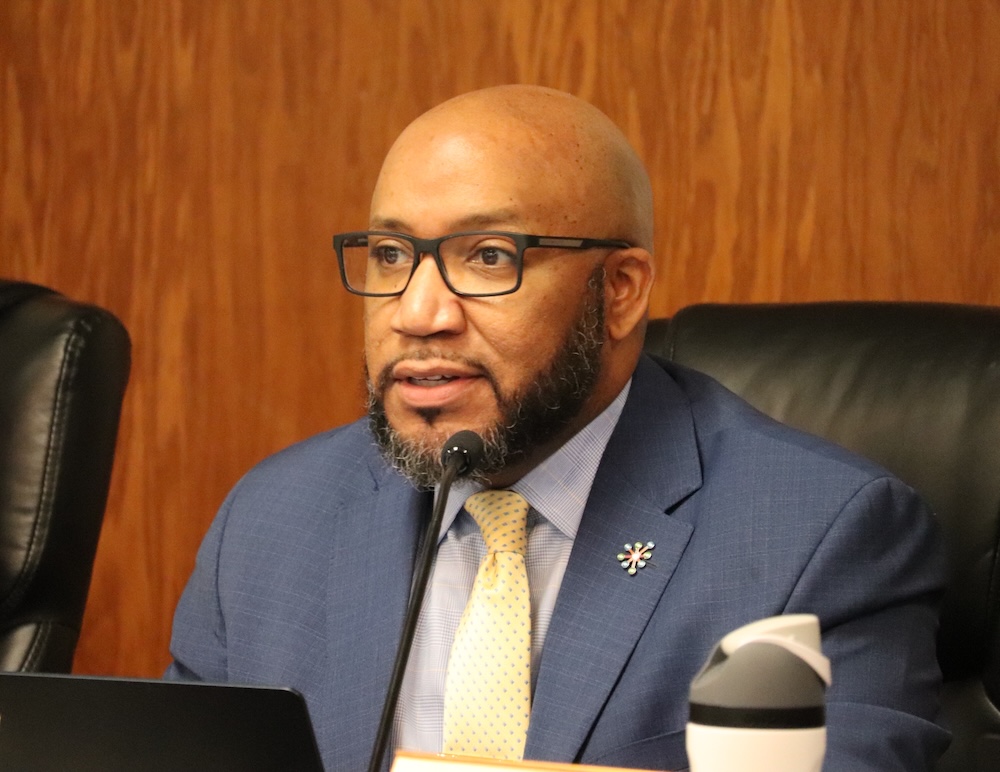
Above: Superintendent Anthony Lewis, pictured at Thursday’s school board meeting. Photo by Reece MacKinney — The 9th Street Journal
Tanya Wan