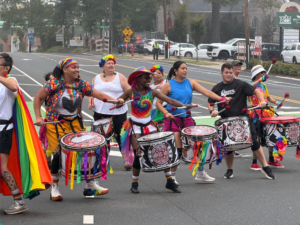
It’s a Saturday morning at Wheels, the indoor roller skating rink in East Durham, and the place has been taken over by the Carolina Roller Derby for a “bout” with a brunch theme, which means the teams have names that invoke breakfast joints — Denty’s vs. Worfle Hause.
The players are in a knot, 5-on-5, when the referee’s whistle starts the action. The players shove and flail to break away until two of the skaters clatter to the rink. Oxford Coma, whose nickname pays homage to a punctuation mark and a terrible injury, emerges from the pack and makes a successful block.
The crowd, a mix of friends, family and derby fans, is shoulder to shoulder around the rink. Some people have come prepared with folding chairs, while others sit cross-legged or lean against the rink barrier.
“Let’s go Ox!”
This is a jam. In roller derby, each jam is similar to a football play, a quick, two-minute burst of action with “blockers” setting up formations while “jammers” try to break through the pack before the referee blows a whistle to reset the field.
In the next jam, Razzle, the Denty’s jammer, shoulders through the pack, shoving Ox, the Worfle Haus blocker, aside. Razzle, wearing sparkly rainbow-striped spandex, checks another blocker, Whackula, to his knees. That makes the jam worth two points for Denty’s (a team earns one point for each blocker passed).

But points aren’t taken too seriously today, since this is a recreational game.
The Carolina Roller Derby has two recreational home teams: the Dogwood Destroyers and the Box Turtle Bruisers; and two competitive travel teams. The Derby opened this bout to skaters from other local leagues to create temporary teams for the day.
The participants wear playful nicknames with double-entendres or silly puns on the backs of their jerseys, a feature from the early 2000s resurgence of roller derby, when an all-women’s team in Austin, Texas revived the sport with inspiration from the punk and drag scenes.
Among the players on this Saturday: Shortcut, Rug Burn, Ash Whooping, Fanny Pack-a-Punch, Elastic, Spidey, and Tenacious T.
The sport was started in 1935 by Leo Seltzer, an entrepreneur who organized dance marathons. The sport fluctuated in popularity before surging in the late 60’s and early 70’s, and then falling off again. In the last 20 years, though, roller derby has been on the rise.
In 2005, 20 flat-track roller derby leagues joined forces to create the sport’s first governing body for women’s derby. One of the founding members was the Carolina Roller Derby, known then as the Carolina Rollergirls, which brought the sport to the Triangle in 2004. Today, the Women’s Flat Track Derby Association represents more than 400 leagues worldwide.
The sport requires muscles and skill, but includes a dose of theatrical flair. It has feminism at its core, and has become a welcoming place for the trans community. The association’s mission statement says, “We provide an inclusive space for women and gender-expansive individuals through healthy athleticism, competition, and community.”
* * *
Don’t let the sparkly spandex fool you. Roller derby is a challenging sport.
Hits and blocks demand balance and strength, while skating requires endurance and agility. A game (sometimes called a “bout”) is a full-body workout.
“I don’t really know if people understand all that goes into it, the physical commitment,” says Whackula, otherwise known as Willow Cox.
Skaters from all over the Triangle practice two to four times a week at a warehouse in Apex with no air conditioning.
They do warmup exercises, then work on their skills. Like contact drills: Partners shuffle sideways apart, ram into each other’s shoulders, and repeat. Or blocking drills: Two people skate backwards while another player tries to pass them. There are dozens of other drills, most of which end with skaters on the ground.
When asked what the hardest part about roller derby is, Ox has a simple answer, “Roller Derby. It’s a hard sport, period.”
Ox, known off the track as Jamie Roessner, tried running and endurance training for years, and then found roller derby.
“It’s a different kind of sport, a different kind of athleticism,” says Roessner, dripping sweat during practice. “It challenges me in a really healthy way.”
* * *
But for all the hip checks and shoulder shoves, there are more smiles, back pats, and hands extended to fallen derbyers during the morning bout at Wheels. That’s because the Carolina Roller Derby is as much of a community as it is a league.
For many, it’s an opportunity to connect with different kinds of people.
“I love the athletic, competitive aspect, but derby came to me when I needed it,” says Deidre Newport, a 44-year-old aesthetician who goes by Fanny-Pack-a-Punch.
Newport, the league’s most veteran player, joined 12 years ago. At the time, she was struggling to adjust to motherhood and searching for an outlet that was “more than just a mommy group”.
Roller derby gave her exactly that.
“I’m surrounded by people of all different ages and backgrounds, folks I probably wouldn’t meet otherwise,” she says. “I mean, I wouldn’t usually be hanging out with 20-year-olds, right? But this is something different.”
Roessner, a 38-year-old writer, echoes that sentiment, highlighting how roller derby connects people “from all walks of life… I don’t typically spend time with people under 25, but here, I’ve made friends of all ages.”
For others, it’s the opposite. Derby is about finding the familiar.
“For me, the biggest thing is that there are other trans people here,” says Anna-Lucas Banas. “It’s been awesome to come into a specific athletic space that is very open and accepting and affirming.”
The 21-year-old student swam competitively for 13 years, but quit their college swim team after feeling unwelcome.
“I’m trans, so I found it really, really, hard to find a sports environment where I felt comfortable,” Banas says.
Banas tried water polo, rugby, track, and even pingpong, but says none of them offered “a space for people like me.”
And then Banas found roller derby.
Banas is now known on the flat track as Riptide Striker, a name inspired by their swimming career.
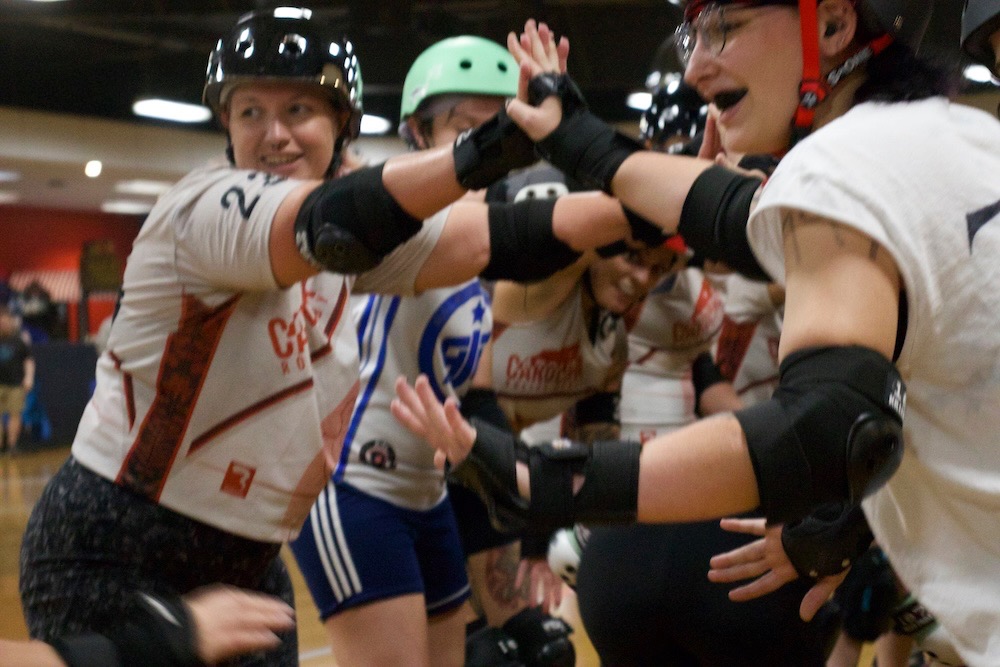
“I want people to understand that roller derby is a hard sport, and that trans people belong in this hard sport… even though we’re part of the Women’s Flat Track Derby Association, this is not a woman’s sport, that anybody who is gender expansive, gender queer, a woman, woman identifying, is safe here and that they can play here,” Roessner says.
For many, the sense of camaraderie is what they treasure the most.
“Derby,” Newport says, “is community.”