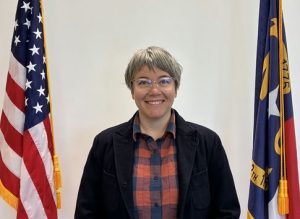
Every day, Satana Deberry’s job reminds her that not all crimes cause the same degree of harm.
“Until you’ve seen an autopsy of a 10-month-old whose father shot her point-blank in the head as a way to terrorize her mother, you’re not being traumatized,” she said. “And that is very different than a 16-year-old sitting in a park smoking marijuana.”
In North Carolina, district attorney offices decide which cases go to court, which ones to divert and which ones should be addressed by involving community organizations. As Durham County’s two-term district attorney, Deberry strives to emphasize prosecuting violent crime. She hopes to continue doing so if reelected in the county’s March 3 election.
Deberry’s campaign manager, Daniel Patterson, praises her focus.
“She has definitely been well-molded for this position, and as Durham’s chief prosecutor, she is clear that public safety is not negotiable and her office prioritizes serious and violent crime,” he said.
Patterson also points to what he calls her track record of success.
“Since she’s been the district attorney, we’ve seen homicide justice go up in terms of clearance and conviction rates,” he said. “We also have the fastest sexual assault kit clearance and most cold case prosecutions in North Carolina and that is the direct success of her office and her leadership.”
Deberry says she’s proud of her office’s many accomplishments, including its driver’s license restoration initiatives, its expunction of certain juvenile misdemeanor charges, its restorative justice work and the prosecution of Craig Hicks, a man convicted of murder in the 2015 Chapel Hill killings of three Muslim young adults.
A record under scrutiny
Deberry is not without her critics. Public records have fueled questions about her presence in the DA’s office. Reporting by WRAL last February indicated that Deberry was in the office for 55% or less of work days in 2020, 2021 and 2024.
Deberry denies the allegations, claiming they were based on “bad swipes.”
“This is a 24/7 job,” she said. “I am always the district attorney of Durham County, whether I am sitting in that chair or I am teaching trial practice at North Carolina Central, or testifying in front of Congress.”
Her challenger, Jonathan Wilson II, says Durham crime victims often feel unheard, and some have not received notifications of court dates.
Deberry dismisses these claims as “campaign speech,” pointing to her “legal and ethical responsibility to notify victims.” Her office employs a legal assistant whose job is to call victims and send out court notices, she said.
“I think that is a way to get people upset about something that’s not true,” she said. “When he’s talking about cases getting dismissed for lack of victims, those are generally misdemeanor cases, and when we find them, we bring them back.”
Wilson also wants the DA’s office to focus more on truancy. Deberry thinks that’s a misguided view.
“There are literally thousands of other people in Durham County who not only work on this issue but have the expertise to work on this issue,” said Deberry, naming schools, community groups and the Department of Social Services. “I’m not a child development expert. I’m an expert in the prosecution of criminal law.”
From Hamlet to Durham’s top prosecutor
A native of Hamlet, North Carolina, Deberry began attending Princeton University in 1987. She originally studied molecular biology, hoping to fulfill her dream of becoming a pediatric surgeon.
However, a class on the social bases of individual behavior changed her mind.
“It just really opened my eyes to a systemic nature of injustice,” Deberry said. “There are so many things that interact with our lives in a way that is invisible to us, but are really shaping what our paths are.”
From there, law school was a natural next step. In 1994, Deberry graduated from Duke Law School. She went on to practice criminal defense law, run nonprofits such as Habitat for Humanity of Durham and the North Carolina Housing Coalition and serve as the general counsel to the North Carolina Department of Health and Human Services.
Working in the worlds of defense, policy and advocacy, she quickly saw limits to what she could do. She was only inching clients away from the edge of a cliff that they were bound to fall off of.
That’s why she originally decided to run for district attorney in 2018.
“The real ability for change is not being the advocate who’s pushing against the door, it’s being the door,” Deberry said. “And now I’m the door. I’m the decision-maker.”
Bill Thomas, a criminal defense attorney at Thomas, Ferguson & Beskind, believes she has been an effective DA.
“I have found her to have outstanding integrity and ethics, and I think she exercises sound discretion and judgment,” said Thomas, who has practiced law since 1979. “She has as strong a desire to protect the innocent as she does to convict the guilty.”
Last year, when Thomas couldn’t reach an agreement with the DA assigned to one of his clients’ cases, he met with Deberry and obtained what he called a “just resolution.”
“Her door was always open. If you call and say ‘I really need to talk to you about a case,’ she will meet with you,” he said. “Not all DAs are like that.”
For Deberry, the role carries higher stakes in the current political climate. She has watched in alarm as the rule of law is threatened across the country.
“We see at a national level right now how important the rule of law is. You see what happens when prosecutors give in to the will of an executive branch…,” she said.
“I’m here to hold us to those standards, make sure that our rights are protected and that we’re safe.”
Above: Photo of Satana Deberry by Lena Nguyen — The 9th Street Journal
Yaa Bame