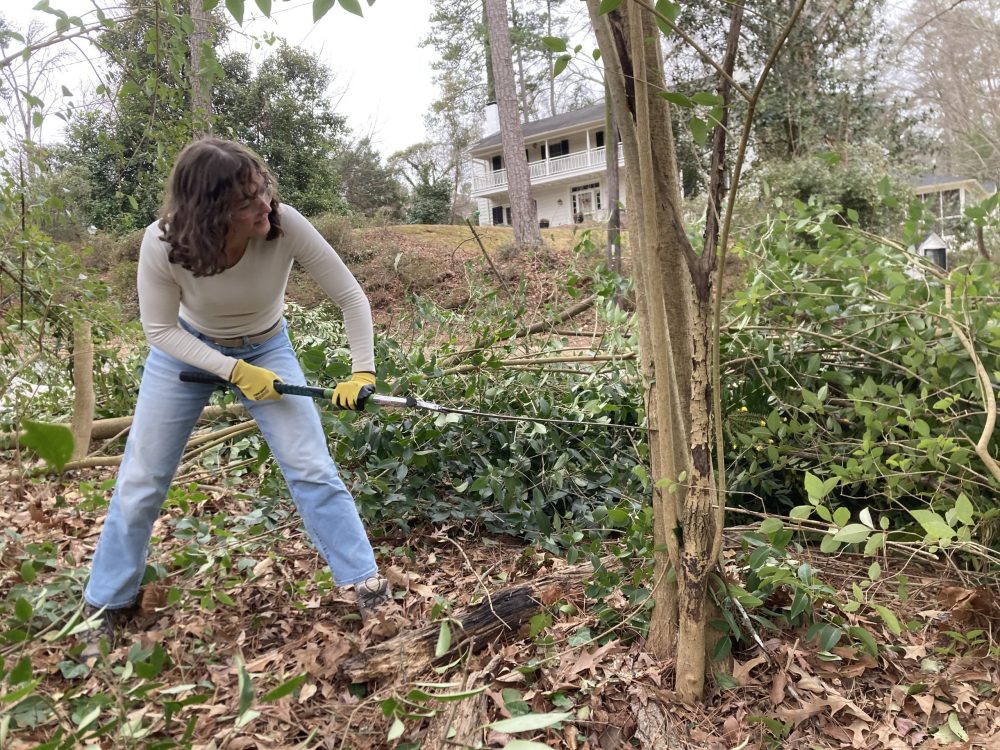
Huge piles of tree branches crowded the curb bordering Forest Hills Park. Volunteers armed with gardening loppers, protective glasses, and herbicide attacked thickets of brush. It was 10 a.m. on a cold Saturday morning, but for those who gathered at the park, this was just another day fighting invasive plants around Durham.
The event, organized by the nonprofit Keep Durham Beautiful, started with a crash course on invasive species removal. Invasive plants are fast-growing species, often imported from other regions, that hog resources and disrupt local ecosystems, harming native plants and wildlife.
Megan Brame, a physician’s assistant and an event organizer, explained that the main target species for the day was privets, evergreen shrubs with symmetrical, dark green leaves. At Forest Hills, volunteers were focused on two types of the shrubs: Chinese and glossy privets. These plants grow in thickets in wooded areas across North Carolina and are classified as “severe threat” invasives according to the North Carolina Native Plant Society. When privets create thick blankets of shade, native species are sometimes unable to get the sunlight and resources they need. Brame explained that when invasives crowd out native plants, insects and other wildlife also suffer.
Brame handed out saws with curved blades, branch loppers, and glasses to protect against sawdust or flying twigs. She also passed out a special kind of dauber, a variant of the type of soft-tip marker commonly used in bingo. These daubers are filled with herbicide and colorful ink so users can easily apply the herbicide solution onto the stems and stumps of cut plants to prevent regrowth of invasives. After briefly walking through removal strategies, the volunteers were trained and ready to go.
Steven Feuerstein, another event organizer and the founder of ReWild Earth, a network dedicated to environmental restoration, emphasized how easy it is to get involved in invasive plant removal. Most volunteers who come to the plant removal events have never taken part before. However, Feuerstein said that with only 15 minutes of training, people can have a “long-term impact for decades to come.”
And on Saturday, these 42 volunteers made a noticeable difference.
As some participants spread out through the diminishing groves of privets, mimosa trees and patches of English ivy, others dragged branches twice their size to a growing curbside pile.
Each month, the event organizers plan multiple invasive plant removal events at parks around Durham to “spread the love” around the city, Brame said.
Tania Dautlick, executive director of Keep Durham Beautiful, said she hopes to pair invasive plant removal with other events such as native tree planting. These events “serve as a community connector where we’re all working together towards a common goal,” she said.
Volunteer Khalil Smith, a senior at Hillside High School, arrived with a school service and leadership development club. He sawed through the base of a tall mimosa tree leaning perilously over a stream until, with a call of “timber,” the tree splashed into the rocky creek below. Smith clapped and smiled triumphantly. “It’s fun because it’s organized chaos,” he said of the event.
The opportunity to give back to the community is what keeps people coming back each month. “People get addicted to it,” Brame said.
Feuerstein wants to get as many people involved in invasive plant removal as possible. He hosts scores of invasive plant removal events each year through ReWild Earth. He also runs a dauber exchange program where anyone can order refillable herbicide daubers kits to aid their own battles against invasive plants.
“So many people are concerned about the environment,” Feuerstein said. “Figuring out a way to take effective action is really hard….So what I want to do is make it as easy as possible for people.”
Above: Kat Lazar takes a saw to an overgrown privet bush in Forest Hills Park. Photo courtesy of Steven Feuerstein
Winslow Tracy