Student misbehavior incidents and short-term suspensions are on the decline in Durham schools, according to preliminary numbers from the district. Long-term suspensions remain high, however.
“Thank you to every educator that has spent so much time making these improvements…as we work towards zero suspension, zero absenteeism,” said board member Natalie Beyer.
The last academic year marked the district’s lowest total number of misbehavior incidents in four years at 14,161, down from nearly 20,000 the year before. Those incidents range greatly in severity, from dress code violations to assaulting other students.
The numbers tell a mixed story for standard disciplinary practices such as suspensions. While short-term suspensions declined on the whole, reaching a three-year low for secondary students, long-term suspensions increased by 10 students between the last academic year and the year before.
In the 2022-2023 school year, 11.74% of secondary students and 3.09% of elementary students experienced short-term suspensions; last year, only 9.38% of secondary students and 2.23% of elementary students experienced short-term suspensions.
Although the 70 long-term suspensions recorded last year mark an increase from the year before, this still shows improvement from the years immediately following the COVID pandemic. Long-term suspensions reached a high of 93 students in the 2022-2023 school year.
Reducing suspensions remains a key goal in the school system’s strategic plan and an ongoing challenge to the district. The district has long sought to emphasize restorative justice practices over exclusionary disciplinary practices like suspensions.
“Long-term suspensions can be appealed to the board of education,” Beyer said, looking across the room. “I need our community to know that. I need to start seeing some [appeals] again.”
At the meeting, board members and speakers noted that several studies have raised questions about the effectiveness of school suspensions. According to research, suspensions can worsen student behavior, attendance, and academic performance.
Nationally, students with disabilities and students of color, in particular Black students, are disproportionately affected by short- and long-term suspensions. A similar pattern holds true in Durham, according to data presented at the meeting.
“Suspension is not an evidence-based practice,” Eliza Strickland, the parent of a DPS student with a disability, said tearfully. “The evidence we do have is that it does more harm than good…We shouldn’t be suspending pre-K students with disabilities.”
As part of its strategic plan, the school district has worked to “reduce suspensions and [promote] restorative practices.” Since 2024, more than 360 staff have been trained in restorative practices by Peaceful Schools, a nonprofit organization that specializes in this approach.
Part of the district’s shift towards restorative practices involves funding Restorative Practices Centers (RPCs) in Durham schools. The centers serve as an “immediate, short-term intervention that provides structured separation from the general student population,” with a focus on relationship-building and accountability in lieu of punitive disciplinary measures, according to Brogden Middle School’s webpage.
Across elementary and secondary schools, the percentage of students assigned to RPCs last year reached a three-year low. This may be a result of the declining number of total misbehaviour incidents.
Compared to the 2022-2023 academic year, secondary students’ RPC assignments fell by more than three percentage points to 7.92% in the last year. In that same time period, elementary students’ RPC assignments declined from 2.79% to 1.69%.
Noting the relatively small percentage of white females receiving disciplinary referrals, board member Emily Chavez questioned the possibility of “positive bias” affecting students in schools. “Black males are still 10 times more likely to be referred to an RPC,” she observed.
“One of the things that you’ll see in discipline is that you can have a phrase like ‘insubordination,’” said Chanel Sidbury, assistant superintendent of school support and continuous improvement. “What is ‘insubordination’…who is likely to be marked more as ‘insubordination’ [sic] versus others? That is work ahead of us.”
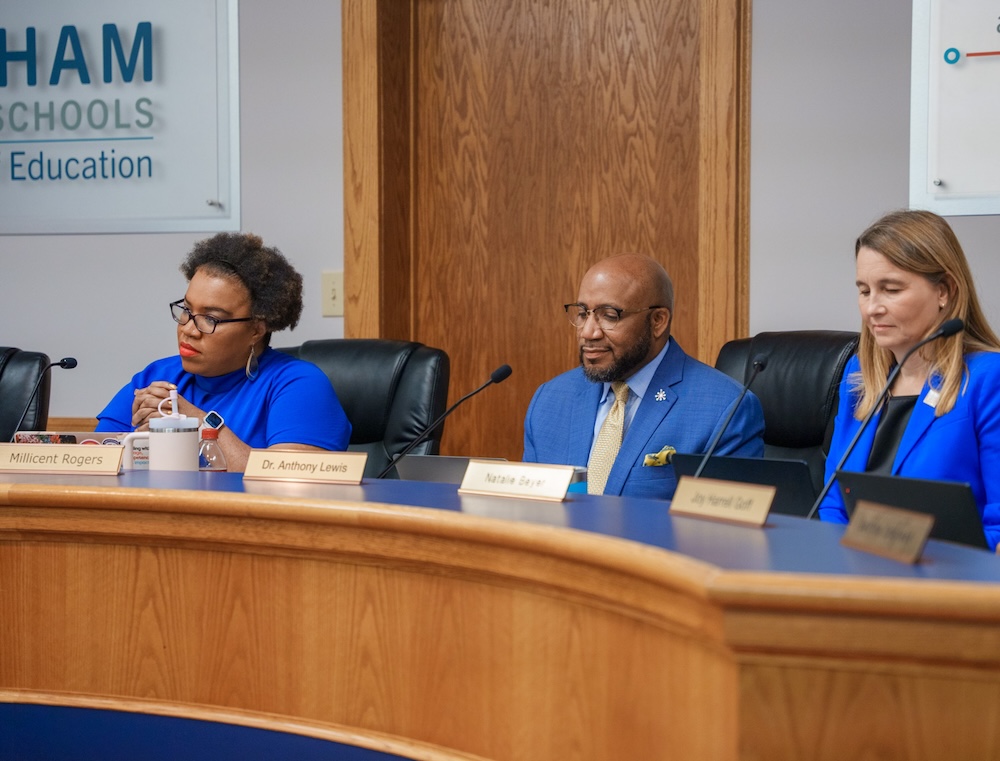
Above: School board members Millicent Rogers (left) and Natalie Beyer (right) and Superintendent Anthony Lewis listen to audience comments during a previous school board meeting. Photo by Kulsoom Rizavi — The 9th Street Journal
Tanya Wan