“What’s the pushback tonight?” Durham Mayor Leonardo Williams asked Mayor Pro Tempore Mark-Anthony Middleton, as they got into an elevator before a City Council meeting Sept. 2.
“The infrastructure is at capacity,” Middleton said.
“Jesus Christ,” Williams said.
The elevator descended from the second floor of City Hall, dropping Williams and Middleton closer to the mass of constituents.
“We’re gonna get mean-mugged tonight,” Williams said.
On the agenda: a contentious plan to annex more than 300 acres in southeast Durham, paving the way for construction of up to 1,750 housing units and 1.4 million square feet of commercial development. The meeting would run more than four and a half hours.
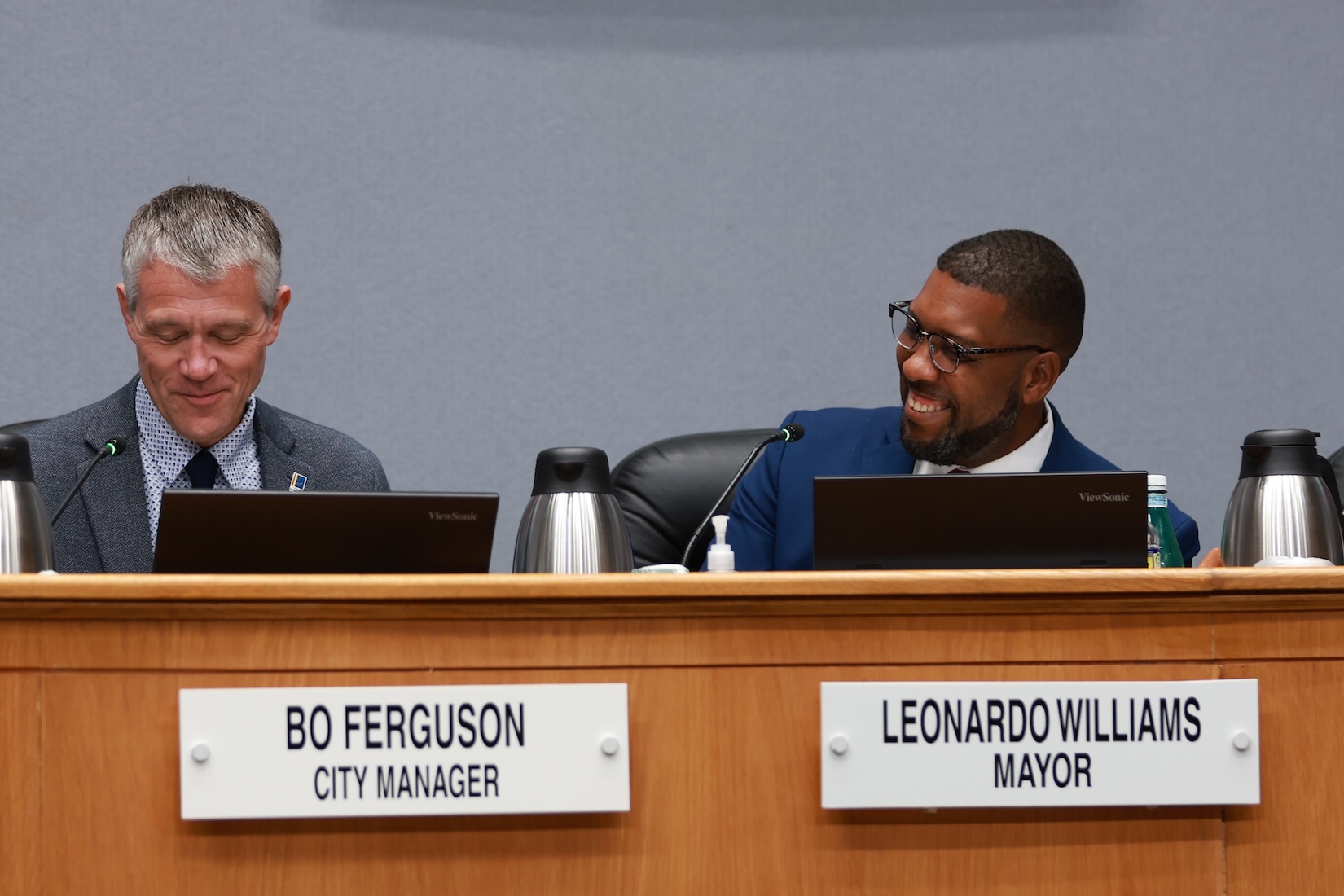
As Williams seeks a second term, he hopes his rallying cry “Durham is Dope” will remind voters of the vibrant city he leads. Charisma helped him win the election in 2023, but charm isn’t synonymous with patience. And this meeting, like others in which he’s been “mean-mugged,” shows his occasional weariness of unhappy constituents and frustration with the “amount of people who have no idea how this job works.”
Williams says he’s just trying to move a sluggish bureaucracy. “I’m very impatient when it comes to getting things done,” he said in an interview with The 9th Street Journal. “City government moves very slow. …While I have learned to become more patient, my job is to also apply pressure.”
The mayor invoked his trademark slogan during Council announcements. “You know it’s election season, and you hear a lot of folks talk about what’s wrong with the city. Guys, let me tell you: Durham is dope,” Williams said..
He continued laying on the kumbaya with a shuffling of agenda items. Williams front-loaded the meeting with a sure-win vote on Durham’s Fourth Amendment Workplace Resolution. (Council camaraderie isn’t uncommon for social issues in the blue Bull City.)
Coming amid President Donald Trump’s crackdown on immigration and ICE raids nationwide, the resolution specified that all city departments will uphold the Fourth Amendment to the U.S. Constitution, which guarantees “the right of the people to be secure in their persons, houses, papers and effects, against unreasonable searches and seizures.”
Members of SiembraNC, a grassroots group focused on informing people of their rights, were unmissable in matching turquoise tees. Durham CAN, a community organizing group, and the Durham Workers’ Rights Commission also turned out.
“This council doesn’t always agree, but I got each and every last one of my colleagues’ backs,” the mayor said before motioning a vote.
The resolution passed unanimously. Attendees rose to their feet, applauding and cheering and embracing before bee-lining to the door.
Williams laughed. “Now y’all ready to stay for the zoning cases?”
From educator to entrepreneur to elected official
Towering at 6-foot-5-inches and generous with his toothy grin, Leonardo Williams, 44, plays the jazz saxophone, comes from a generation where “dope” doesn’t mean drugs and jokes that he “sells chicken for a living.” (Williams and his wife, Zweli, own local restaurants.) Durham swooned for him in 2023, electing him mayor with nearly two-thirds of the vote.
Now, Durhamites will weigh not just Williams’ swagger, but his record as the incumbent, as he runs for reelection with the slogan “Durham is Dope – Because of Us.”
He grew up in eastern North Carolina before moving to Durham to attend North Carolina Central University. He majored in music education and served as NCCU’s drum major before earning a master’s degree in education leadership.
Williams taught middle and high school and held administrative positions. Twice, Durham Public Schools named him teacher of the year. His City Hall debut came in Dec. 2021 when he joined the Durham City Council.
While at NCCU, Williams met his now-wife Zweli, whom he married once they reconnected 13 years after graduation. They have a son, Izaiah, who attends Duke University.
Williams’ experiences as a teacher and business owner informed his decision to run for mayor in 2023.
“I felt that I wanted to see the city support education more. And I wanted to see the city support entrepreneurship more. And I wanted to be the elected official to do that,” Williams said.
“From educator to entrepreneur to elected official. That’s my story.”
Williams defends “common sense” development
When the Gateway at Brier Creek annexation plan came before the Council, an army of residents commanded the podium — and in the case of constituents tuning in virtually, unmuted their Zoom microphones. “My number one concern as a lifetime cardiac patient who has already had a heart attack wants confirmation that an ambulance can and will be able to pick me up and get me to a hospital,” announced Monique Fletcher. “This really sounds unlike the proposed ‘21,000 plus vehicles per day’ increase.”
Council members Nate Baker and Chelsea Cook prolonged debate with objections and questions. Eventually, Williams had heard enough and fussed at them to use “common sense.”
Durhamites have seen this impatience before. In February, 89 registered speakers wanted to weigh in on a proposed rezoning on Pickett Road and an annexation on the edge of the county in Moriah Ridge. Williams clipped public comment from three minutes to one.
“If we were to have everyone speak for three minutes, then we would be here all night,” he said at that meeting.
The Sept. 2 annexation case was the latest example in a list of several contentious development proposals the mayor championed. The plan will transform 308 acres of mostly forested land on Durham County’s side of Brier Creek. It’s half a square-mile, which City Council member Nate Baker noted is five-times the area of the downtown loop.
Commercial development plans call for an industrial park, warehouses, medical offices and retail space, plus a one-acre park. Housing units include apartments, townhomes, detached row homes and single-family homes.
Members of Preserve Rural Durham, an organization dedicated to protecting Durham’s natural landscapes from overdevelopment, spoke against the project. Members flashed slideshows and poster boards decorated with environmental, safety and traffic concerns.
A handful of residents supported the project for its contributions to Durham’s economic growth via property tax.
Williams was not swayed by Preserve Rural Durham’s complaints. “If this is not a better case than most, then I don’t know what the heck is. The opposition to it is what I hear on every single case. … I think we need to come to reality here and actually start focusing on what makes common sense, what is realistic in the society in which we live in,” Williams said before opening the vote.
The annexation passed 4-2. Council members Javiera Caballero, Mark-Anthony Middleton and Carl Rist joined the mayor in favor, while Nate Baker and Chelsea Cook opposed the proposal. Councilwoman DeDreana Freeman was absent from the meeting.
Navigating criticism
Former Mayor Steve Schewel calls Williams “a warm person, he’s extremely inclusive, he listens to all voices with an open mind.” But Schewel, who backed him in the last election, says he doesn’t plan on endorsing any candidate this year, including Williams.
Williams does have some key endorsements under his belt, including the Durham Committee on the Affairs of Black People, the Friends of Durham and the People’s Alliance PAC.
The People’s Alliance said, “he has made good use of his time on City Council, learning how to effectively enact change that benefits the Durham community while working towards consensus and coalition building with people he does not always agree with on difficult policy decisions.”
His opponent Anjanée Bell, daughter of longtime Durham Mayor Bill Bell, says Williams is out of touch with the Bull City because of his bigger political ambitions. “What I learned from my dad, that I think is what I see now in this current leadership, is that Durham is not a plan B,” she said.
“A lot of the criticism, you know, can reside in the fact that he was not present in the city as much as perhaps the city needed — because there was a focus elsewhere.”
Williams spoke at the Democratic National Convention in Aug. 2024, and he’s headed to speak at The Clinton Foundation’s annual meeting in New York later this month.
“If the residents of Durham see fit for me to be in another position, then I guess we’ll cross that bridge when we get there,” Williams said.
Pamela Andrews, the founder of Preserve Rural Durham, said they have invited every leader to see some of the county’s environmental concerns. “Leo Williams has never come for a tour,” Andrews said. (Williams said while he has not accompanied Andrews, he has visited sites in Southeast Durham several times to take note of traffic and environmental concerns.)
“It doesn’t matter how many times we dig facts from other places, we’re dismissed. We’re not listened to. And it’s really sad,” Andrews said.
Another candidate for mayor, Pablo Friedmann, a Durham Public Schools administrator, echoes the complaints.
“It has to be a two-way conversation,” Friedmann said at a Sept. 3 candidate forum.
Williams views the backlash over development as misplaced criticism of capitalism.
“I’m a capitalist,” Williams said. Capitalism, he believes, nurtures small businesses like his restaurants, and allows Durham to grow.
And while the Fourth Amendment Resolution was meant to be another accomplishment to serve a progressive constituency, the celebration was short-lived.
Days after the Sept. 2 meeting, Fox News reported that Durham “declares itself a ‘Fourth Amendment Workplace’ to protect illegal immigrants from ICE.” Angry emails and voice messages packed the mayor’s mailboxes, subjecting Williams to insults such as “liberal ass looney tune Unamerican DemnoRATS” and “inbred goober.”
In 2023, he won the seat with traditional promises about affordable housing, safety and transit. But in office, he often championed major development projects, riling the city’s progressive (and outspoken) voices. Combine that with a conservative national climate, and he’s caught in the crossfire.
Williams ended our interview and returned to writing an op-ed. “I’m naming it a ‘cry for civility.’”
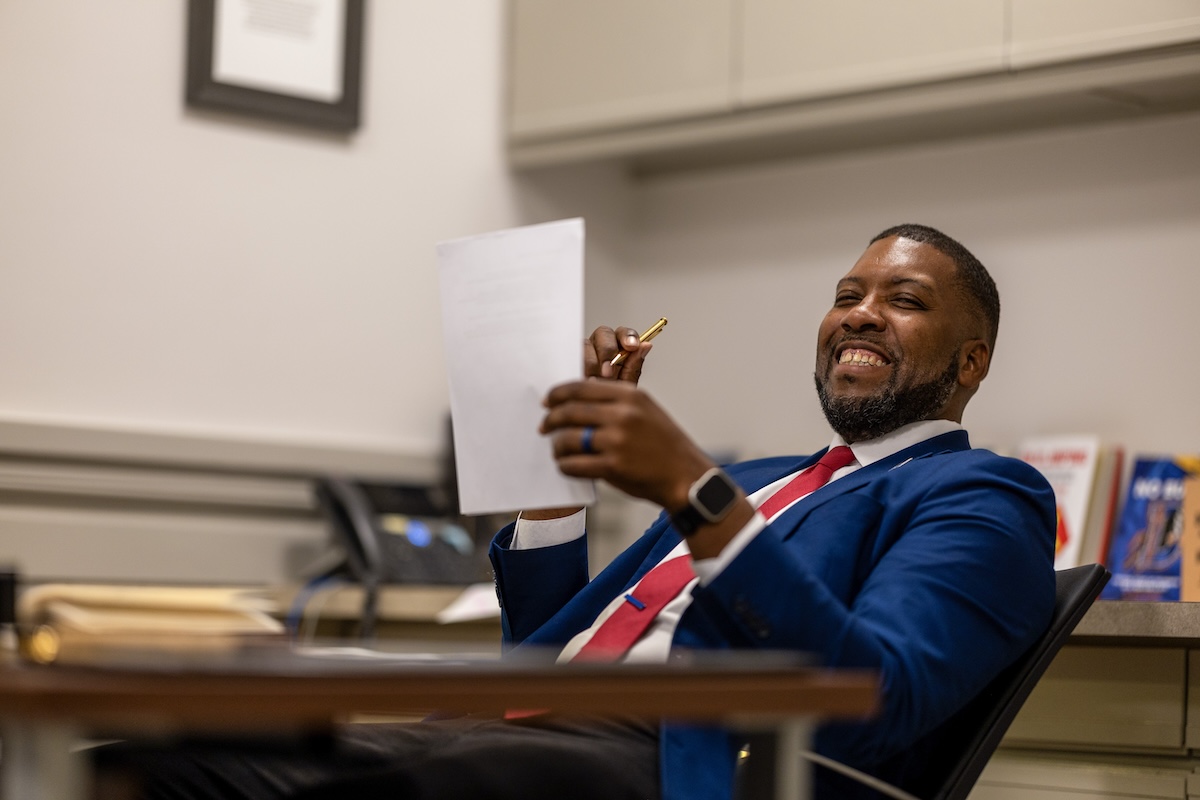
At top, photo of Mayor Leo Williams by Dhruv Rungta – The 9th Street Journal
Gabrielle Lazor